How to Delegate Tasks Effectively and Reclaim Your Time

Learning to delegate isn't just about shuffling tasks off your plate. It’s a fundamental shift in how you lead, one that separates managers who get stuck from leaders who drive real growth.
This isn’t about just handing things off. True delegation means you’re thoughtfully choosing the right person, clarifying the desired outcome, granting them the authority to get it done, and then—this is the hard part—trusting them. Get this right, and you don’t just free up your time; you multiply your impact and build a more capable team.
Why Delegation Is Your Secret Weapon for Growth
Let's be honest. The thought, "It's just faster if I do it myself," has crossed every leader's mind. And for a single, isolated task, you might even be right. But that thinking creates a hard ceiling on what you and your company can ever hope to achieve.
When you hold onto every task, you become the bottleneck. The real cost isn't just your own time. You're actively stunting your team's development, speeding toward your own burnout, and missing out on the strategic work that only you can do because you're buried in the day-to-day details.
Effective delegation isn't about losing control. It’s about multiplying your effectiveness. When you start seeing it as an investment in your people, everything changes. You stop being the primary “doer” and become a multiplier of your team's talent and results.
The Hidden Costs of Not Delegating
The refusal to let go of tasks comes with a steep, often invisible, price tag. It's more than a bad habit; it's a quiet drain on your business's potential.
- Opportunity Cost: Every hour you spend on something a team member could handle is an hour you didn't spend on strategy, nurturing key relationships, or creating your next big breakthrough.
- Team Demotivation: When you don’t trust your team with meaningful work, they notice. It quietly signals a lack of confidence, which kills morale and prevents people from ever feeling true ownership.
- Founder Burnout: The "I'll do it all" mindset is a one-way ticket to exhaustion. Burnout doesn’t just make you less productive; it can extinguish the very passion that got you started.
Think about it this way: a founder who spends hours every week manually writing follow-up emails is a founder who isn't refining the product roadmap or closing a game-changing deal. That lost time is a real, quantifiable loss. You can explore how using an AI for email responses might claw back some of those hours, but the core issue is a human one that technology alone can't fix.
The Hidden Costs of Not Delegating
Many professionals underestimate the financial impact of doing everything themselves. The table below shows what those "quick tasks" really cost in lost revenue opportunities.
| Professional Profile | Time Spent on Delegatable Tasks (Weekly) | Estimated Lost Billable Hours (Weekly) | Annual Revenue Opportunity Cost |
|---|---|---|---|
| Solo Consultant | 10 hours | 8 hours | $62,400 (@ $150/hr) |
| Agency Owner | 15 hours | 12 hours | $140,400 (@ $225/hr) |
| Startup Founder | 20 hours | 15 hours | Varies (e.g., missed funding) |
| Senior Manager | 12 hours | 10 hours | Varies (e.g., delayed projects) |
Seeing the numbers in black and white makes it clear: micromanagement isn't just a leadership flaw, it's a direct hit to your bottom line.
The choice is stark: you can be the bottleneck that limits growth, or the leader who builds a system that scales beyond your own two hands. Delegation is that system.
The Undeniable Link Between Delegation and Growth
The difference between leaders who delegate effectively and those who don’t shows up directly on the balance sheet. This isn't just about management style—it's about measurable results.
A landmark Gallup survey of CEOs found something startling. Leaders who had a high talent for delegation saw their companies achieve an average three-year growth rate of 1,751%. That was a full 112 percentage points higher than their peers who struggled to let go.
The study also found that among Inc. 500 CEOs, the high-delegators generated 33% more revenue. Their companies brought in an average of $8 million, compared to just $6 million for the low-delegators.
This is no accident. When you empower your people, you create an environment where they take initiative, solve problems, and grow into their roles. This frees you up to focus on the future, making delegation an urgent, strategic imperative for any business that's serious about growth.
Identifying What and When to Delegate
The secret to great delegation doesn’t start when you hand a task over. It starts with a hard look at your own plate. Too many leaders fall into the trap of only delegating the easy stuff—expense reports, meeting invites—and miss the huge opportunity to offload work that actually moves the needle.
Before you can delegate anything, you have to know where your time is really going. This means getting brutally honest with yourself. For one week, track everything. Not just the big projects, but every "quick five-minute favor" that mysteriously eats up your afternoon. Only then can you see the full picture and make smart choices about what to let go of.
This isn't about just clearing your to-do list; it's about shifting from being a bottleneck to being a force multiplier for your team.
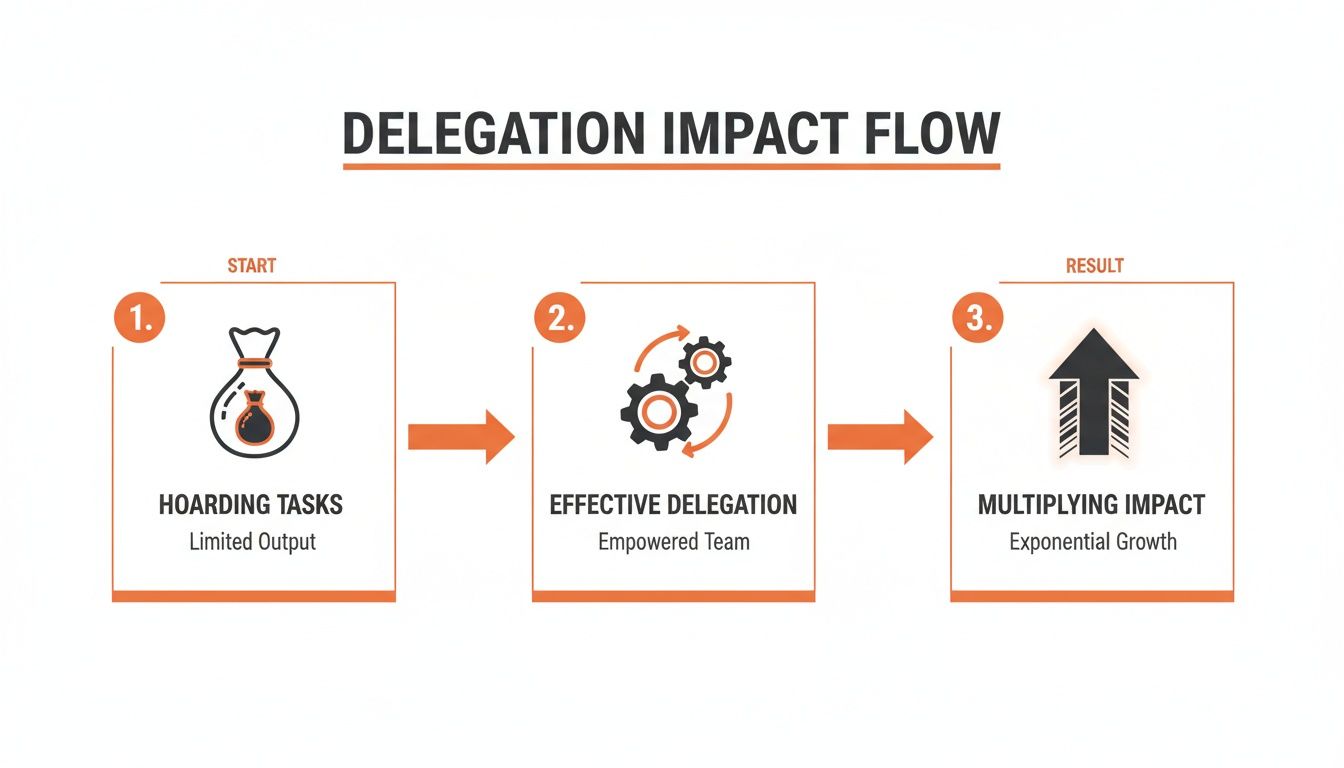
When you hoard tasks, you limit what's possible. But when you start delegating with purpose, you unlock your team's true potential and multiply your collective impact.
Using the Effort vs. Impact Matrix
One of the best tools I've found for this audit is the simple Effort vs. Impact matrix. It’s a straightforward way to sort every task into one of four buckets, giving you instant clarity on what to keep, what to delegate, and what to ditch entirely.
Here's how it breaks down:
- Low Effort, Low Impact: These are your prime candidates for delegation or automation. Think routine data entry, scheduling, or formatting reports. They have to get done, but they don't need you.
- High Effort, Low Impact: This is the danger zone—the time sinks. These tasks drain your energy with very little to show for it. You have to ask: Can someone else do this? Even better, does this need to be done at all?
- Low Effort, High Impact: These are your quick wins. Handle these yourself. It could be giving the final green light on a proposal or providing a quick piece of feedback that unblocks your team.
- High Effort, High Impact: This is your sweet spot, your "Zone of Genius." This is the strategic, creative work that truly requires your expertise. Your goal should be to spend most of your time right here.
Once you’ve sorted your tasks, the path forward becomes obvious. It’s not about having an empty plate; it’s about making sure your plate is filled with the right things.
Finding Teachable and Repetitive Tasks
Beyond the matrix, keep an eye out for tasks that are both teachable and repetitive. If you can document a process for something you do over and over, you can almost certainly delegate it. Sometimes, you might find that you can automate it instead. For example, looking into email automation for small business can be a game-changer for handling recurring communications.
Let's look at a couple of real-world scenarios:
- The Founder: A startup founder was spending 5 hours a week creating and scheduling social media posts. For her, this was High Effort, Low Impact. She handed it off to a marketing-savvy junior employee who was thrilled to learn, turning it into a growth opportunity for them and freeing up her own time for investor meetings.
- The Consultant: A consultant personally cleaned and organized raw data for every new client project—a classic High Effort, Low Impact time-drain. They created a clear standard operating procedure (SOP) and delegated the initial data prep to an analyst. This let them focus on interpreting the findings and delivering strategic insights, which is what the client was really paying for.
Overcoming the "Faster Myself" Trap
We’ve all been there. The little voice in your head says, "It's just faster if I do it myself." And for a one-off task, you might even be right. But that thinking is a trap that will keep you buried in low-value work forever.
The time you invest upfront to teach someone else pays you back again and again.
Delegating isn't just about freeing up your time; it's an investment in your team's capability. Every task you teach is a skill they gain and a responsibility you permanently offload.
You have to get comfortable with the fact that the task might not be done exactly your way, and that's okay. As long as the outcome meets the standard, a different approach can be a great thing. Getting past this mental block is the first real step toward becoming a leader who truly scales.
Matching the Task to the Right Person
When you're swamped, it's tempting to just toss a task to the first person with any bandwidth. We've all done it. But this "first available" approach is one of the biggest mistakes a manager can make, and it almost always leads to mediocre work and frustration on both sides.
True delegation isn't just about offloading work. It’s about thoughtful matchmaking. When you align a task with the right person's skills, interests, and potential for growth, you do more than just get something done. You actively build a more capable and engaged team.
Getting this wrong has a very real cost. Managers often get stuck redoing work themselves—one study found they spend about 14% of their time correcting employee errors that come from a poor handoff. In contrast, research shows that thoughtful delegation that empowers employees leads to higher job satisfaction and much stronger performance. You can read more about the connection between psychological empowerment and task performance in the study that uncovered these findings.
Look Beyond Skills to Ambition and Growth
Knowing who's good at what is just the starting point. Great delegation digs deeper into your team’s career goals and where they're hungry to grow. A task that feels like a chore to one person can be the exact opportunity another has been waiting for.
For instance, say you have a junior analyst who’s great with numbers but mentioned wanting more client-facing experience. They are the perfect candidate to draft that upcoming client presentation. It lets them use their existing analytical skills as a foundation while safely stepping into a new area they want to develop.
Before you delegate, run through these quick questions:
- Who has shown interest in this kind of work before? Think back to your one-on-ones or performance reviews.
- Whose career goals does this task actually support? Consider where they want to be in a year or two.
- Who has the raw potential, even if they don’t have the full experience yet? Giving someone a "stretch" assignment is one of the best ways to show you believe in them.
A task is never just a task. It's a chance to show your team member, "I see your potential, and I'm invested in helping you reach it." This is how you build loyalty that lasts.
Connect the What to the Why
If you want a job done poorly, just hand it off without any context. People do their best work when they understand how their contribution fits into the bigger picture. Never assume they already know why it matters.
Instead of saying, "Please compile a report on our competitor's social media," try this:
"I'd like you to put together a report on our top three competitors' social media. This is a huge help because we're planning our Q3 marketing strategy next month, and your insights will directly shape the campaigns we run. I picked you for this because I've been really impressed with your analytical eye."
This does two powerful things at once:
- It provides context, which empowers them to make smarter decisions without you.
- It shows respect, making them a true owner of the outcome, not just a pair of hands.
Define the Outcome, Not the Method
You’ve picked the right person and explained the "why." Now you need to clearly define the "what"—the final destination. This means being crystal clear about the desired result, how you'll measure success, and what "done" actually looks like.
Here's the tricky part: you have to resist the urge to dictate the "how." This is where so many well-meaning leaders fall into the micromanagement trap. When you prescribe every single step, you strip away any opportunity for problem-solving, creativity, and real ownership.
Your job is to set the boundaries, not the complete path.
| Element to Define | What to Provide | What to Avoid |
|---|---|---|
| The Outcome (What) | "We need a final, client-ready deck by Friday at 5 PM." | "First, you need to open PowerPoint and use this template..." |
| The Constraints | "Keep the final report under 10 pages and use data from the past six months." | "Your first draft must be done by Tuesday at noon for my review." |
| The Resources | "You have access to the company's analytics subscription and last year's report." | "Check in with me every two hours with a progress update." |
Set the destination, give them a map and a compass, and then trust them to navigate the journey. This balance is absolutely fundamental if you want to learn how to delegate tasks effectively and build a team that operates with confidence and autonomy.
Crafting a Handoff That Guarantees Clarity

So, you’ve pinpointed the right task and found the perfect person for the job. Now for the moment where so many good intentions fall flat: the handoff. I've seen it happen a hundred times. A rushed email or a quick "can you handle this?" is a recipe for disaster. You get confusion, missed deadlines, and work that you end up having to redo yourself.
A truly effective handoff isn't just about sending instructions. It's about deliberately setting your team member up to win from the very beginning. You’re not just passing off a task; you're transferring context, resources, and the confidence they need to run with it.
When you nail this step, you’ll see a shift. You stop being a firefighter and start seeing genuine ownership from your team. This is a non-negotiable part of learning how to delegate tasks effectively.
The Anatomy of a Perfect Delegation Handoff
Think of your handoff message as a complete starter kit. It should anticipate and answer every immediate question your team member might have, leaving absolutely no room for guesswork. The goal is to create a single source of truth they can always refer back to. This one move eliminates the endless back-and-forth that makes delegation feel like more trouble than it’s worth.
Here’s the essential information to include every single time:
- The Big Picture: Why does this task matter? Connect it to the larger goal. For example, "We need to analyze the customer feedback from Q3 to find the top three feature requests. This will directly inform our next development cycle."
- The Definition of Done: Be crystal clear about what "finished" looks like. Is it a spreadsheet? A ten-slide presentation? A drafted email? Don't leave it to interpretation. For instance, "This is 'done' when we have a one-page summary document with supporting charts ready for review."
- Key Resources and Access: Give them everything they need. Provide direct links to documents, tools, and contacts. Don't make them waste time hunting for information. For example, "All the raw survey data is in this Google Drive folder, and the login for our analytics platform is in 1Password."
- The Final Deadline (and Milestones): State the final due date clearly. For larger projects, add a check-in or two. This isn't micromanagement; it's just making sure the train stays on the tracks.
The most common failure point in delegation is assuming your team has the same context you do. They don't. Your job during the handoff is to close that context gap completely.
To make sure you've covered all your bases, here’s a quick checklist you can use for every handoff.
Delegation Handoff Checklist
Use this checklist to ensure every delegated task is handed off with complete clarity and all necessary context.
| Checklist Item | What to Include |
|---|---|
| Objective | The "why" behind the task and its impact on the bigger picture. |
| Definition of Done | A clear, specific description of the final deliverable. |
| Resources & Tools | Direct links to all necessary files, software, and login credentials. |
| Key Contacts | Names of people they might need to collaborate with. |
| Level of Authority | What decisions can they make independently? |
| Deadlines & Milestones | The final due date and any interim check-in points. |
| Confirmation | A prompt for them to confirm they have everything they need. |
Running through this list before you hit "send" can save you hours of clarification later.
Using Technology for a Cleaner Handoff
In a busy environment, the right tech can make your handoffs cleaner and more consistent. Project management tools like Asana or Trello are brilliant for this. They create that single source of truth we talked about, keeping all the task details, files, and conversations in one organized place. No more digging through email chains or Slack channels to find that one critical piece of information.
AI assistants are also changing the game, especially for founders, consultants, and anyone drowning in email. Delegating via AI can mean drafting clear, personalized communications in an instant. For example, a tool like Draftery.ai can generate drafts for each person in your own voice, saving users 12.5 hours weekly on 50+ emails. Because it learns your unique tone—your formality, phrasing, even your emoji use—from your email history, the drafts appear naturally threaded in your Gmail. This makes the handoff process incredibly fast and consistent. As the Employers Council notes, empowering your team starts with clear communication, and tools like this can be a huge help.
A Practical Delegation Handoff Template
Putting it all together, a great delegation email can be simple yet incredibly thorough. Whether you post this in a project tool, a chat message, or an email, the core elements are the same.
Subject: New Task - Competitor Analysis for Q4 Strategy
Body:
Hi [Team Member Name],
I'm handing off the Q4 competitor analysis to you. Your insights here are going to be critical for our strategy session next month, and I immediately thought of you because of your great analytical work on the last project.
- Objective: The goal is to create a summary of our top 3 competitors' recent marketing campaigns and product launches.
- Definition of Done: A 5-slide presentation deck that covers the key findings for each competitor, with a final slide on potential opportunities for us.
- Resources:
- Links to competitor websites are in the project folder.
- Access to our market intelligence subscription is in LastPass.
- Deadline: Please have the final deck ready for review by Friday, October 28th. Let's also pencil in a quick check-in on the 21st just to see how it's going.
Let me know if you have any questions before you dive in
Following Up Without Micromanaging
You’ve handed off the task, you’ve been crystal clear about the outcome, and now… you wait. This is often the hardest part. The urge to constantly check in, to ask for little updates, is powerful. But this is the moment many well-intentioned leaders stumble straight into micromanagement, undoing all the trust and ownership they just built.
Effective follow-up isn't about control; it's about support. You’re there to be a safety net, not a cage. The goal is to give your team member enough structure to feel secure but enough freedom to solve problems, learn on their own, and genuinely own the result.
Getting this right is what separates managers who truly empower their people from those who just use them as a pair of hands.
Set a Rhythm for Check-Ins
The easiest way to avoid the "just checking in" trap is to agree on a check-in schedule before the work even starts. This one simple step removes a ton of anxiety for both of you. They know exactly when an update is expected, and you know when you'll get one.
There's no magic formula here—the right cadence depends entirely on the person and the project.
- A seasoned pro on a familiar task? They've earned your trust. A quick weekly touch-base or even just a final review before the deadline might be all you need.
- A junior person taking on a big stretch goal? More frequent check-ins are your friend. You might start with a 15-minute sync-up every morning for the first few days, then dial it back to twice a week as they find their footing.
- A complex, multi-month project? Forget random check-ins. Schedule your follow-ups around key milestones. This keeps the conversations focused on tangible deliverables, not just a vague sense of "progress."
By tailoring the schedule, you’re showing that you see them as an individual and understand the unique demands of the task. It's a thoughtful approach, not a rigid, one-size-fits-all process.
Coach, Don't Police
When you do check in, your mindset is everything. Your job is to be a resource and a coach, not an auditor hunting for mistakes. You want to create an environment where it’s safe to be honest, even when things are a little rocky.
So instead of asking loaded questions like, "Are we behind schedule?" or "Did you run into any problems?" try framing it differently:
- "How are things feeling on your end?"
- "What's one thing I can do to support you right now?"
- "Are there any roadblocks I can help clear out of your way?"
These open-ended questions invite real conversation. They turn the check-in from a stressful interrogation into a collaborative huddle. If you find yourself too buried in your own tasks to have these quality conversations, improving your email management best practices can create the mental space you need to focus on your team.
Your goal during a check-in is not to find fault. It's to make sure the person feels supported and has a clear path to the finish line. Every interaction should build their confidence, not chip away at it.
How to Give Feedback That Actually Helps
Mistakes are going to happen. It's not just inevitable; it's a critical part of how people grow. The way you handle these moments will determine whether it's a learning opportunity or a confidence-killer.
When feedback is necessary, be specific, objective, and kind. Vague criticism like, "This isn't what I had in mind," is completely unhelpful.
Instead, connect your feedback directly to the standard. For example: "This is a really strong start on the report, and the data in the first section is exactly what we needed. For the next version, let's get the charts aligned with the branding guidelines we went over. Specifically, just swap out these colors for the approved palette, and we'll be good to go."
See the difference? You praise what's working, point to the specific gap, and give them a clear, simple action to fix it. This approach corrects the work without crushing the person doing it. You’re showing them exactly how to get it right, reinforcing that you’re on their side and invested in their success.
Answering Your Toughest Delegation Questions
Even the best delegation plan hits a few bumps in the road. Theory is one thing, but the reality of handing off work to another person can get complicated. Let's tackle some of the most common questions I hear from managers who are trying to get this right.
What if the Person I Delegated to Makes a Mistake?
First off, take a breath. It’s going to happen. Mistakes are a natural, expected part of learning, not a five-alarm fire. Your reaction is what really counts here. Whatever you do, resist the urge to jump in and fix it yourself. That just teaches your team member that you’re the safety net, and they don't have to take full ownership.
Instead, turn it into a coaching opportunity. Sit down with them and get curious about how they got there.
- "Can you walk me through your process on this?"
- "Looking back, where do you think things went off course?"
- "If you were to do this again, what would you change?"
This kind of collaborative review transforms a simple mistake into a powerful lesson. The truth is, 9 times out of 10, the person you delegate to won't be 100% ready. Your job isn't to expect perfection from the get-go; it's to guide them through that learning curve.
How Do I Delegate to Someone Who Resists New Responsibilities?
This is a delicate one, and you have to do a little detective work. Resistance rarely comes from laziness. It’s almost always rooted in one of two things: they feel completely swamped, or they feel insecure. Your first move is a friendly, open chat to figure out why they're hesitant.
If they're overwhelmed, it's time to look at their current plate together. Are their priorities clear? Is there something you can take off their list to make space for this new task? A quick capacity check shows you respect their time and aren't just piling on work for the sake of it.
If the issue is insecurity about their skills, your approach needs to shift to confidence-building.
My favorite move here: Frame the task as a vote of confidence. Try saying something like, "I specifically chose you for this because I've been really impressed with your [specific skill], and I think you're ready to take this on." Then, offer a safety net—maybe more frequent check-ins at first or breaking the project into smaller, less intimidating pieces.
Is It Okay to Delegate a Task I Dislike Doing?
Yes, absolutely! But there's one huge condition: you can't just pass it off as "grunt work" you're tired of. The task has to be framed as a genuine contribution to the team or a real development opportunity for the person taking it over.
Think about the tasks you don't enjoy. More often than not, they're things you've simply outgrown. A repetitive task that bores you to tears could be an incredible chance for a junior team member to master a fundamental business process.
For instance, maybe you hate compiling that weekly sales report. For you, it's tedious. But for someone new, it’s a direct line to learning the core metrics that drive the business. They get to learn the reporting system, see what's working, and understand the company's pulse. Always find a way to connect the task to a bigger purpose.
Are you spending too much time on email to focus on these delegation strategies? Draftery automatically drafts replies in your unique voice, right inside Gmail, giving you back hours each week. Stop writing, start delegating. Start my free trial.