Transcription and Translation: Why People Mix Them Up (And How They Actually Differ)
- No prior knowledge needed
- Basic familiarity with audio or video content
- Interest in making content accessible or reaching global audiences
Introduction: Why understanding transcription and translation matters
If you have ever asked someone to "translate" a recording and received a plain text document in the same language, you have experienced the confusion firsthand. Transcription and translation sound similar, appear together in professional contexts, and are often used interchangeably in everyday conversation. But they describe two fundamentally different processes, and mixing them up can lead to wasted time, miscommunication, and costly mistakes.
The core confusion explained
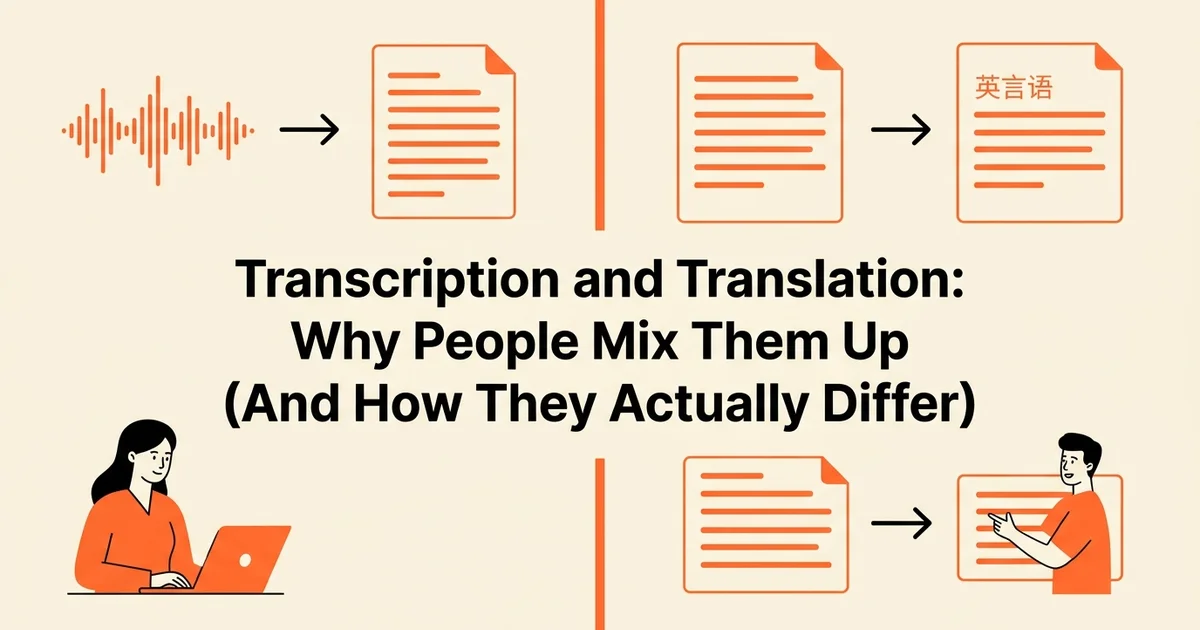
The words share a Latin root and both involve converting content from one form to another. That surface-level similarity is where the resemblance ends. As Certified Languages (2025) puts it, "transcription changes the medium while keeping the language consistent; translation changes the language while maintaining meaning, tone, and intent." In other words, one process changes the format of your content, and the other changes its language entirely.
Why the distinction matters for your work
Getting this wrong has real consequences. A journalist who needs a Spanish interview converted to English text requires translation, not transcription. A podcaster who wants a searchable record of their English episode needs transcription, not translation. Ordering the wrong service means starting over, and in professional settings that delay costs money and credibility.
For students, educators, and business teams, understanding the difference also shapes how you evaluate tools, brief freelancers, and build accessible content workflows.
What you will learn in this guide
By the end of this article, you will be able to confidently define both terms, spot the differences in real-world scenarios, and choose the right approach for your specific needs. Whether you are captioning video content, documenting meetings, or localising a course for a global audience, this guide gives you a practical foundation.
If you want to put transcription into practice right away, Draftery's Meeting Capture and Transcription tool records and speaker-labels your calls across Zoom, Meet, and Teams without requiring a bot to join, giving you an accurate written record the moment your meeting ends.
Table of contents: Your roadmap through this guide
This guide moves step by step from core definitions through to practical application. Use the list below to read straight through or jump directly to the topic most relevant to you right now.
- What is transcription? A clear definition for beginners
- What is translation? A clear definition for beginners
- The core difference between transcription and translation
- Common reasons people confuse the two
- When you need transcription vs. translation
- How transcription works in practice
- How translation works in practice
- Accuracy and quality: what to look for in each
- Tools and technology for transcription
- Tools and technology for translation
- Transcription service pricing: what to expect
- Choosing the right approach for your project
- Key takeaways and next steps
What is transcription? A clear definition for beginners
Transcription is the process of converting spoken audio or video into written text, keeping everything in the same language. Think of it as creating a written record of what was said. Nothing is translated, reworded into another language, or interpreted. The words simply move from sound to page.
The core idea: same language, different format
According to Certified Languages (Year), transcription turns speech into written text while keeping the original language intact. That last part is crucial. If someone speaks in English, the transcript is in English. If someone speaks in Spanish, the transcript is in Spanish. The language never changes. Only the format does, shifting from audio to text.
A helpful analogy: imagine a court stenographer sitting in a courtroom, typing out every word a witness says. They are not interpreting meaning or switching languages. They are simply capturing speech as written words in real time. That is transcription in its purest form.
Everyday examples of transcription in action
Transcription shows up in more places than most people realize:
- Podcast episodes: A host records a 45-minute conversation, and a podcast transcription service converts it into a readable article or show notes.
- Business meetings: A team records a Zoom call and receives a speaker-labeled text document summarizing exactly who said what.
- Interviews and research: A journalist records a source interview and transcribes it to pull accurate quotes.
- Lectures and classes: A professor records a lesson, and students receive a written version to study from later.
What transcription does NOT do
This is where a lot of confusion starts. Transcription does not:
- Convert content into another language
- Summarize or paraphrase what was said
- Interpret meaning or add context
- Replace subtitles for a foreign-language audience
If your meeting was held in English and you need a written record in English, transcription is exactly what you need. If you need that content in French or Mandarin, that is a different process entirely, which the next section covers in full.
What is translation? Understanding language conversion
Translation is the process of converting meaning from one language into another. Where transcription stays within a single language, translation crosses linguistic boundaries entirely. According to Certified Languages (Year), translation changes the content from one language into another, making it accessible to audiences who speak a completely different tongue.
Translation is about meaning, not just words
Here is where many beginners get tripped up: translation is not simply swapping each word for its foreign equivalent. A skilled translator preserves the intent, tone, and meaning of the original content, even when that requires restructuring sentences or choosing culturally appropriate phrasing.
Think of it like this. If you ask a friend to explain a joke from another culture, they do not translate it word for word. They find the closest equivalent that will actually land with your audience. That is exactly what good translation does.
Why word-for-word translation fails
Direct, literal translation, sometimes called "word-for-word" or literal translation, almost always produces awkward or misleading results. Here are a few reasons why:
- Idioms do not transfer. The English phrase "it is raining cats and dogs" translated literally into another language would be baffling.
- Sentence structure differs. Languages order subjects, verbs, and objects differently. A literal swap produces grammatically broken sentences.
- Cultural context gets lost. Humor, formality levels, and references are deeply tied to culture. A word-for-word approach strips all of that away.
Where you encounter translation in real life
Translation appears across a wide range of everyday situations:
- Business documents converted from English into Spanish for a Latin American market
- Subtitles on a French film adapted for English-speaking viewers
- Legal contracts prepared for international signatories
- Podcast episodes repurposed for global audiences in their native languages
Understanding this distinction matters practically. If you record a meeting in English and need a written record in English, that is transcription. If you then need that written record in Japanese, you need translation. Both are valuable, but they solve entirely different problems.
Key terms you need to know: Building your vocabulary
Before diving deeper into how transcription and translation differ, it helps to get comfortable with the vocabulary professionals use. These terms come up constantly, and mixing them up can lead to real confusion when you are ordering services, describing your needs, or explaining a project to a colleague.
Source language and target language
These two terms appear in almost every translation conversation. The source language is the original language a piece of content is in. The target language is the language you want to convert it into. So if you are translating a Spanish interview into English, Spanish is the source and English is the target.
Transcript versus recording
A recording is the raw audio or video file capturing what was said. A transcript is the written text version of that recording. Think of the recording as a photograph and the transcript as a typed description of what is in it. They contain the same information, just in different formats. You can learn more about specific use cases in our guide to interview transcription.
Interpretation versus translation
People often use these interchangeably, but they are distinct. Translation works with written text. Interpretation is the spoken equivalent, where a professional converts speech from one language to another in real time, such as at a conference or medical appointment.
Subtitles, captions, and closed captions
- Subtitles assume the viewer can hear the audio and translate spoken dialogue into text, usually in a different language.
- Captions transcribe all audio, including sound effects and music cues, for viewers who cannot hear.
- Closed captions (often abbreviated CC) can be toggled on or off by the viewer, unlike open captions which are permanently burned into the video.
Speaker labeling and timestamps
Speaker labeling identifies who said what in a transcript, typically shown as "Speaker 1" or a person's name before each line. Timestamps mark exactly when in the recording each word or phrase was spoken. Both features make transcripts far easier to navigate, especially in long meetings or multi-person interviews.
The core difference: Transcription versus translation at a glance
Now that you have the vocabulary, here is the single most important distinction to lock in: transcription and translation are two completely separate processes that solve two completely different problems. One changes the medium a message travels in. The other changes the language it lives in.
What each process actually does
Think of it this way. Imagine a podcast episode recorded in English. A transcriptionist listens to that audio and types out every word, still in English. The language never changes. Only the format shifts, from sound to text. That is transcription.
Now imagine a French-speaking listener wants to understand that same podcast. A translator reads the English transcript and rewrites it in French, preserving the meaning while switching the language entirely. The format might stay the same (text to text), but the language transforms. That is translation.
According to Certified Languages (Year), transcription changes the medium while keeping the language consistent, whereas translation changes the language while maintaining meaning. That one sentence is the clearest way to hold both ideas in your head at once.
The different skills each requires
These processes are not interchangeable, and neither are the people who perform them.
Transcriptionists need:
- Sharp listening skills and strong attention to detail
- Familiarity with the subject matter (medical, legal, or general)
- Speed and accuracy in typing
- Knowledge of formatting conventions like speaker labeling and timestamps
Translators need:
- Fluency in at least two languages, including cultural nuance
- The ability to carry meaning across linguistic structures that may not map directly
- Subject-matter expertise in specialized fields
- Sensitivity to tone, idiom, and register
A bilingual person is not automatically a skilled translator, just as a fast typist is not automatically a skilled transcriptionist. Both roles take real training.
Why they serve entirely different purposes
Transcription makes spoken content readable and searchable. It helps with accessibility, note-taking, content repurposing, and compliance. Translation makes content accessible to a different audience entirely, crossing language barriers rather than format barriers.
If you need a record of what was said in a meeting, you need transcription. If you need that record understood by a team in Tokyo, you need translation too. Sometimes both are required, but they are always two distinct steps, never one. If you are still weighing your options for getting transcripts done accurately, which transcription sites actually deliver results is worth a look before you commit to a workflow.
Why transcription and translation matter: Real-world applications
Knowing the difference between transcription and translation is useful in theory, but seeing how each one solves real problems makes the distinction click. Both services carry serious weight across industries, from legal compliance to global marketing, and understanding which one you need can save you significant time and money.
Transcription makes content accessible and searchable
Transcription is the foundation of accessibility. For deaf and hard-of-hearing audiences, a written record of spoken content is not a convenience, it is a necessity. Captions on videos, transcripts of podcasts, and written summaries of live events all depend on accurate transcription to exist.
Beyond accessibility, transcription turns spoken content into something machines and humans can search. A recorded meeting is essentially locked information. A transcript of that same meeting becomes a searchable, shareable, referenceable document. This matters enormously for teams working remotely.
Research suggests that nearly 60% of remote workers struggle with information retention from virtual meetings, which means a reliable transcript is not just helpful, it is often the only way key decisions get remembered and acted on. Tools like Meeting Capture and Transcription address exactly this gap, giving teams speaker-labeled, accurate records of every call without requiring a bot to join.
According to Certified Languages International (2024), transcription also plays a critical role in legal and compliance contexts, where verbatim records of depositions, hearings, and interviews are required by law. The U.S. transcription services market reflects this demand, valued at $30.42 billion in 2024.
Video professionals are also leaning into transcription for workflow efficiency. If you work with footage regularly, how video editors are using transcription in Premiere Pro is worth exploring.
Translation reaches audiences across languages and cultures
Translation takes the written record and carries it across language barriers. For businesses expanding into new markets, translating product documentation, marketing copy, or customer support materials is how they make their message land with audiences who speak different languages.
According to Technolex (2024), compliance requirements often demand both services together. A multinational company may need a transcript of a legal proceeding and a certified translation of that transcript for use in a foreign jurisdiction. In those cases, transcription comes first, translation follows, and neither step can substitute for the other.
Types of transcription: Understanding your options
Not all transcription works the same way. Depending on your purpose, you might need every single word captured exactly as spoken, or you might need a polished, readable document that cleans things up. Knowing which type fits your situation saves you time and frustration.
Verbatim transcription
Verbatim transcription captures everything: every word, every filler sound, every stutter, every false start. If the speaker says "um" four times in one sentence, all four appear in the transcript.
Example: "So, um, the, uh, the report is, like, basically ready, I think."
Best for: Legal proceedings, research interviews, and any situation where the exact way something was said carries meaning. A lawyer analyzing a witness's hesitations, for instance, needs every "um" on the record.
Clean transcription
Clean transcription removes filler words, repeated phrases, and minor stumbles while keeping the speaker's meaning fully intact. The result reads more naturally without losing accuracy.
Example: "The report is basically ready."
Best for: Podcasts, interviews, and business meetings where readability matters more than capturing every vocal habit. Most content creators and journalists prefer this format.
Intelligent transcription
Intelligent transcription goes a step further by adding punctuation, paragraph breaks, and light formatting to make the document genuinely easy to read. Think of it as clean transcription with structure built in.
Example: "The report is basically ready. Once we review the final figures, we can send it to the client."
Best for: Meeting notes, educational content, and any transcript that people will read rather than just reference. Tools like speaker-labeled transcription software often produce output close to this standard automatically.
Choosing the right type matters more than most people realize. As The Hidden Complexity Behind Professional Audio Transcription explains, even small formatting decisions shape how useful a transcript actually becomes in practice.
Types of translation: Knowing what you need
Just as transcription has distinct formats suited to different purposes, translation is not a single, uniform service. Choosing the wrong type can mean a document that is technically accurate but completely misses its audience. Understanding your options upfront saves time, money, and embarrassing mistakes.

Literal translation: Word-for-word accuracy
Literal translation (also called direct translation) converts text as closely as possible to the original wording. It works well for technical documents, legal contracts, and academic texts where precise meaning must be preserved. However, it can produce awkward, unnatural phrasing in everyday communication because languages do not map onto each other word-for-word.
Best for: Legal filings, scientific papers, and official records where every term carries specific weight.
Localization: Adapting for culture and context
Localization goes beyond words. It adapts tone, idioms, cultural references, and even formatting so that content feels native to its target audience. A marketing campaign translated literally from English to Japanese might be grammatically correct but culturally tone-deaf. Localization fixes that.
Best for: Marketing copy, product interfaces, social media content, and anything designed to persuade or connect emotionally.
Machine translation versus human translation
Machine translation tools like Google Translate are fast and free, making them useful for quickly grasping the gist of a foreign-language document. Human translators, by contrast, understand nuance, context, and cultural subtext in ways that algorithms still struggle to replicate consistently.
The quality gap matters most in high-stakes situations:
- Legal and medical content: Errors can have serious consequences, so human review is essential
- Marketing and brand messaging: Tone and personality require a human touch
- Internal notes or quick reference: Machine translation is often perfectly adequate
As What Makes a Great Online Transcription Tool? A Co... notes about transcription, accuracy standards should always match the purpose of the final document. The same logic applies directly to translation choices.
How transcription works: The step-by-step process
Transcription follows a clear sequence: audio or video goes in, and a written text document comes out. Understanding each stage helps you get better results and avoid common mistakes, whether you are transcribing a podcast episode, a business meeting, or a recorded lecture.
Prepare your audio or video file
Gather the audio or video content you want to transcribe. Ensure the file is in a common format (MP3, WAV, MP4, etc.) and check that the audio quality is clear. Poor audio quality will affect transcription accuracy, so if possible, use a high-quality recording.
Choose your transcription method
Decide whether you'll use automated AI transcription tools, manual transcription, or a hybrid approach. AI tools are faster and more affordable, while manual transcription offers higher accuracy for complex content. Consider your budget, timeline, and accuracy requirements.
Upload and process your content
Submit your file to your chosen transcription tool or service. Most modern platforms will automatically process the audio and generate a draft transcript. This step typically takes anywhere from a few minutes to several hours depending on file length and tool capacity.
Review and edit the transcript
Carefully read through the generated transcript and make corrections. Pay special attention to proper nouns, technical terms, and any sections where the audio was unclear. This quality-check step is crucial for accuracy, even with advanced AI tools.
Format and finalize your document
Add timestamps, speaker labels, and any necessary formatting to make your transcript readable and searchable. Save your final document in your preferred format (Word, PDF, plain text, etc.) and store it securely for future reference.
Preparing your audio input
Start by recording or gathering your audio file. Common formats include MP3, WAV, MP4, and M4A. Quality matters here. Background noise, overlapping speakers, and low volume all make the transcription process harder, whether a human or an AI tool is doing the work. Aim for clear, close-mic audio whenever possible.
If you are capturing a live call or meeting, tools like Draftery's Meeting Capture and Transcription record both sides of the conversation directly from your Mac, without needing a bot to join the call. This means cleaner audio from the start.
Speaker identification and labeling
Once the audio is processed, the next step is assigning each spoken segment to the correct person. This is called speaker diarization (identifying and labeling who said what). You might see output like "Speaker 1:" or actual names if the system has been trained to recognize them. Accurate speaker labeling is especially important for interviews, panel discussions, and multi-person meetings where context depends on knowing who is speaking.
Adding timestamps
Timestamps mark exactly when each word or phrase was spoken, usually formatted as [00:01:45]. These are invaluable for video editors, journalists, and anyone who needs to jump to a specific moment in a recording. If you are creating captions for video content, timestamps are not optional. They are the backbone of the entire process. You can learn more about putting timestamped transcripts to work in our guide to generating professional video captions in minutes, not hours.
The role of AI versus human review
AI transcription has become remarkably fast and affordable, but it still struggles with heavy accents, technical terminology, and overlapping speech. According to CNTI research on AI transcription in journalism, human oversight remains essential for high-stakes content where errors carry real consequences.
A practical approach: let AI handle the first pass, then have a human reviewer check for accuracy before the transcript is used in any official or public-facing context.
How translation works: From source to target language
Translation takes a finished text in one language (the source language) and converts its meaning into another language (the target language). Unlike transcription, which is about capturing words accurately, translation is about capturing meaning accurately, which is a much more interpretive process.
Prepare your source text
Start with a complete, well-written text in your source language. Translation works best when the original text is clear and polished. If translating from transcribed audio, ensure the transcript has already been reviewed and edited for accuracy and clarity.
Select your translation approach
Choose between machine translation (fast and affordable), professional human translation (higher quality and nuance), or a hybrid approach combining both. Consider the importance of tone, cultural context, and technical accuracy for your specific project.
Translate the content
Submit your text to your chosen translation tool or service. Machine translation tools will generate an instant translation, while professional translators may take days or weeks depending on content length and complexity. The translator focuses on preserving meaning, tone, and intent—not just word-for-word conversion.
Review for accuracy and tone
Check the translated text for accuracy, readability, and cultural appropriateness. Verify that idioms, technical terms, and cultural references have been properly adapted for the target language. This step is essential regardless of whether you used machine or human translation.
Finalize and deliver
Format your translated document to match your needs and ensure consistency with your brand voice or style guide. Save in your preferred format and deliver to stakeholders. Keep both source and target versions for future reference and updates.
Understanding the source text first
Before a translator writes a single word in the target language, they read the entire source text for comprehension. This matters because a word at the beginning of a document might only make full sense once you reach the end. Translators look for tone, intent, cultural references, and implied meaning, not just vocabulary.
Context shapes every decision. The phrase "break a leg" translated literally into another language produces nonsense. A skilled translator recognises it as an idiom and finds the cultural equivalent in the target language instead.
The role of subject matter expertise
Translation is not a generic skill. A medical document, a legal contract, and a podcast transcript each require different specialist knowledge. Translators working in technical fields need to understand the subject deeply enough to choose the right terminology, not just the closest dictionary match. Mistranslated medical or legal terms can carry serious consequences, which is why subject matter expertise is considered non-negotiable in professional translation.
Quality assurance and review
Professional translation workflows typically include at least two stages after the first draft: editing (checking for accuracy and meaning) and proofreading (checking for grammar, spelling, and consistency). Many agencies use a TEP process, which stands for Translation, Editing, and Proofreading, as a standard quality benchmark.
Where machine translation falls short
Machine translation tools like Google Translate have improved dramatically, but they still struggle with idioms, cultural nuance, ambiguous phrasing, and domain-specific terminology. Human translators bring judgment, cultural fluency, and accountability that automated systems cannot replicate, especially for content that will be published, broadcast, or used in formal contexts.
When to transcribe first, then translate: The recommended workflow
For most multilingual content projects, the right order is clear: transcribe the audio first, then translate the written text. Skipping the transcription step and attempting to translate directly from audio is a common shortcut that almost always produces weaker results, because translators work best with stable, reviewable written source material.
Why the order matters
Think of transcription as laying a foundation. When a translator works from a written transcript, they can re-read ambiguous sentences, check context, and flag unclear phrasing before committing to a target-language equivalent. When they work directly from audio, they are essentially doing two cognitively demanding jobs at once: listening and translating simultaneously. That split focus increases the risk of missed words, misheard terms, and meaning errors that are hard to catch later.
According to Certified Languages (Year), transcription and translation are distinct professional disciplines, and treating them as a single step blurs the quality controls that each stage provides independently.
The two-stage workflow in practice
Multilingual meeting workflows increasingly follow a structured two-stage process: first, create an accurate source-language transcript, then pass that transcript to a translator or translation tool. This approach is now common across several real-world contexts:
- International business teams: A meeting recorded in English is transcribed with speaker labels, then translated into French, Spanish, or Mandarin for regional colleagues who were not present.
- Global podcasts: Hosts record and transcribe episodes in their native language, then use the transcript as the source file for translated subtitles or dubbed scripts.
- Multilingual content production: Journalists and educators capture interviews in one language, transcribe them accurately, and then commission translations for international audiences.
How transcripts improve translation quality
A clean, accurate transcript gives translators a reliable source document they can annotate, query, and return to. It also makes the review process far more straightforward. Editors can compare the source text and the translated text side by side, sentence by sentence, which is simply not possible when the only source material is an audio file.
If your workflow involves recording meetings or calls in multiple languages, a tool that captures speaker-labeled transcripts automatically, like the Meeting Capture and Transcription feature in Draftery, gives you a ready-made source document that feeds directly into the translation stage without any extra manual work.
Common beginner mistakes to avoid
Even with a clear understanding of what is difference between transcription and translation, it is easy to stumble when putting that knowledge into practice. These six mistakes trip up beginners most often, and knowing them in advance will save you significant time and frustration.
Mistake 1: Assuming transcription and translation are the same thing
This is the most fundamental mix-up of all. Transcription converts speech to written text in the same language. Translation moves meaning from one language to another. Treating them as interchangeable leads to skipped steps and poor-quality output.
Mistake 2: Translating audio directly without transcribing first
Jumping straight from audio to translated text skips the quality-control layer that a written transcript provides. Without a transcript, errors in the source content go undetected and get baked into your final translation.
Mistake 3: Expecting 100% accuracy from AI tools without human review
AI transcription tools are impressive, but they are not perfect. According to the Center for News, Technology & Innovation (2024), accuracy and accessibility vary significantly across tools, and continued human oversight remains important. Always review AI-generated output before passing it to a translator.
Mistake 4: Ignoring speaker identification in transcripts
Unlabeled transcripts create confusion, especially in interviews or multi-person meetings. Speaker labels (for example, "Speaker A" or a person's name) tell translators who said what, which matters for tone and context. Draftery's Meeting Capture and Transcription feature automatically applies speaker labels to recordings, giving you a structured source document from the start.
Mistake 5: Using generic translation without cultural localization
Word-for-word translation often misses idioms, humor, or cultural references. Localization (adapting content so it feels natural to the target audience) is a separate, essential step beyond basic translation.
Mistake 6: Forgetting about accessibility requirements
Transcripts are not just useful for translation. They are often legally required for accessibility compliance. Skipping transcription means skipping captions, searchable text, and screen-reader compatibility for audiences who need them.
Getting started: Your first steps with transcription
Transcription converts spoken audio into written text. Whether you are a podcaster turning episodes into blog posts, a student capturing lecture notes, or a journalist documenting interviews, the process follows the same core steps. Here is how to get started confidently.
Identify your transcription need
Determine what you want to transcribe and why. Are you capturing podcast episodes, lecture notes, interview recordings, or meeting minutes? Understanding your purpose helps you choose the right tool and transcription type (verbatim, clean read, or edited).
Select a transcription tool
Research and choose a transcription platform that fits your needs. Popular options include Otter.ai, Rev, Sonix, and Google Docs voice typing. Consider factors like accuracy rates, pricing, turnaround time, and whether you need speaker identification or timestamps.
Upload your first audio file
Start with a shorter audio file (5-10 minutes) to test the tool's accuracy and workflow. This low-stakes trial run helps you understand the platform before committing to larger projects. Most tools offer free trials or credits for new users.
Review and edit the output
Carefully read through the generated transcript and make necessary corrections. Note which types of errors the tool made (proper nouns, technical terms, accents, etc.) so you can adjust your approach for future transcriptions.
Save and organize your transcript
Store your completed transcript in a logical folder structure with clear naming conventions. Include metadata like the original speaker, date, and topic. This organization makes it easy to search and reference transcripts later.
Choose your transcription method
Start by deciding which approach fits your needs:
- AI transcription: Fast, affordable, and ideal for clear audio with one or two speakers. Most tools return results in minutes.
- Human transcription: More accurate for complex audio, heavy accents, or technical vocabulary. Slower and more expensive.
- Hybrid: AI handles the first pass, then a human editor reviews and corrects. A solid middle ground for professional use.
For most beginners, AI transcription is the natural starting point.
Prepare your audio or video files
Good transcription begins with good audio. Before uploading anything:
- Listen back and note any sections with background noise, crosstalk, or unclear speech.
- Trim silence from the start and end of the file.
- Save in a widely supported format such as MP3, WAV, or MP4.
The cleaner your source file, the more accurate your transcript will be.
Select a transcription tool or service
Look for a tool that matches your workflow. If you record meetings, calls, or in-person conversations, a dedicated app makes a real difference. Draftery's Meeting Capture and Transcription, for example, records both sides of calls on Mac without requiring a bot to join, and returns speaker-labeled transcripts automatically. That speaker labeling feature (which identifies who said what) saves significant editing time.
Review and edit the transcript
No automated transcript is perfect. Read through the output carefully, correcting names, technical terms, and any mishearing the AI flagged. What you should see: a clean, readable document that matches the original audio closely.
Add timestamps and speaker labels if needed
Timestamps (markers showing when each line was spoken) are essential for video captions and interview references. Add speaker labels to clarify who is speaking, especially in multi-person recordings.
Export in your preferred format
Most tools offer exports as plain text, Word documents, SRT caption files, or PDFs. Choose the format that fits your next step, whether that is publishing captions, sharing notes, or archiving the record.
Getting started: Your first steps with translation
Translation converts written content from one language (the source language) into another (the target language). Unlike transcription, which captures what was said, translation focuses on meaning, tone, and cultural context. Here is how to begin confidently.
Clarify your translation goals
Define what you're translating, which languages are involved, and why the translation matters. Are you translating for a global audience, legal compliance, marketing, or personal use? Your purpose determines the type of translation you need (literal, localized, or specialized).
Choose your translation method
Decide between machine translation (Google Translate, DeepL) for speed and affordability, or professional human translation for higher quality and cultural nuance. For business-critical content, consider a hybrid approach: machine translation followed by professional review.
Start with a small sample
Translate a short section (a paragraph or page) first to test your chosen method. This helps you evaluate quality, turnaround time, and cost before committing to a full project. It also gives you a chance to provide feedback or adjust your approach.
Review the translation carefully
Read through the translated text and compare it to the original. Check for accuracy, readability, and cultural appropriateness. Look for awkward phrasing, mistranslated idioms, or technical terms that may have been handled incorrectly.
Iterate and finalize
Make necessary revisions based on your review. If using machine translation, consider having a native speaker review it. Once satisfied, format your final translation, save it with clear naming conventions, and store it alongside your source document for future reference.
Determine your target language and audience
Start by identifying exactly who you are writing for. A Spanish translation for a Mexican audience may differ significantly from one aimed at speakers in Spain. Knowing your audience shapes vocabulary choices, formality level, and cultural references throughout the translated content.
Decide between machine translation and human translation
Machine translation uses software to convert text automatically. Tools like DeepL or Google Translate are fast and free, making them useful for getting a quick sense of foreign content. Human translation involves a professional translator and is slower and more costly, but far more accurate for nuanced, sensitive, or specialized material. For casual internal notes, machine translation may be sufficient. For published content, client-facing documents, or anything legally sensitive, invest in a human translator.
Choose a translation tool or service
For machine translation, DeepL and Google Translate are widely used starting points. For human translation, platforms like ProZ or Gengo connect you with vetted professionals. Match the tool to your accuracy requirements and budget.
Provide context and a glossary for specialized terms
Give your translator, whether human or machine, as much context as possible. Include a short brief explaining the subject matter, the intended audience, and any brand-specific terminology. A simple glossary (a list of key terms with their preferred translations) prevents inconsistencies across longer projects.
Review for accuracy and cultural appropriateness
Read the translated content carefully. Watch for phrases that are technically correct but sound unnatural, or references that may not land well in the target culture.
Test with native speakers if possible
Share a draft with a native speaker of the target language before publishing. Their feedback often catches subtle errors that even skilled translators miss.
Tools and resources for beginners: What's available
Whether you need to capture spoken words accurately or convert content between languages, there are more tools available today than ever before. Knowing what each type of tool does, and how to choose between them, saves you time and frustration before you commit to a workflow.
AI transcription tools
AI transcription tools convert audio or video into written text automatically. They have improved dramatically in recent years, and the market reflects that growth: the AI transcription market was valued at $4.5 billion in 2024 and is projected to reach $19.2 billion by 2034, signaling strong adoption across industries from journalism to education.
Popular options include tools that work directly in your browser, as desktop apps, or through integrations with your existing meeting software. When evaluating them, look for:
- Speaker labeling: Does the tool identify who said what? This matters enormously for interviews, meetings, and podcasts.
- Language support: Most leading tools support 30 to 50+ languages, but accuracy varies significantly by language.
- Accuracy on accents and technical vocabulary: General accuracy rates can be misleading if the tool struggles with your specific content.
For teams and professionals who spend a lot of time in meetings, Draftery's Meeting Capture and Transcription is worth exploring. It runs as a Mac menu-bar app, records both sides of calls on Zoom, Google Meet, Teams, or in-person conversations, and delivers speaker-labeled transcripts, all without requiring a bot to join your call. That last point matters if you work in contexts where uninvited bots feel intrusive or unprofessional.
A growing trend in this space is the combination of capabilities: AI meeting assistants increasingly bundle live transcription, summaries, translation, and task extraction into a single tool, reducing the number of apps you need to manage.
Translation services
Translation tools fall into two broad categories: machine translation (like Google Translate or DeepL) and human translation services. Machine translation is fast and free or low-cost, making it ideal for getting the gist of a document quickly. Human translation is slower and more expensive but essential when accuracy and cultural nuance matter.
How to compare tools for your needs
Use these four criteria when evaluating any transcription or translation tool:
- Accuracy: Test it on a sample of your actual content, not a generic demo.
- Languages supported: Confirm your specific language pair or dialect is covered.
- Cost: Consider per-minute, per-word, or subscription pricing against your expected volume.
- Speed: Determine whether you need real-time output or whether batch processing works for your use case.
Matching the tool to your actual workflow, rather than choosing the most popular option, is what separates beginners who struggle from those who hit the ground running.
Myths and misconceptions: What beginners often get wrong
Even after exploring the available tools, beginners often carry a few stubborn misunderstandings about transcription and translation. Clearing these up early saves a lot of frustration and helps you make smarter decisions about which service you actually need.

Myth: Transcription and translation are the same thing
They are not. As Certified Languages (2025) explains, "Transcription changes the medium while keeping the language consistent; translation changes the language while maintaining meaning, tone, and intent." One converts audio to text. The other converts meaning across languages. Different jobs entirely.
Myth: AI transcription is always 100% accurate
No AI tool achieves perfect accuracy in every situation. Background noise, accents, overlapping speakers, and technical jargon all introduce errors. According to the Center for News, Technology & Innovation (2024), a study reviewing seven transcription tools across 846 speakers and 194 hours of content found that accuracy and accessibility vary significantly across platforms. Always review AI output before relying on it.
Myth: Translation is just swapping words
Word-for-word substitution produces awkward, often misleading results. Real translation preserves meaning, tone, and cultural context, not just vocabulary.
Myth: AI tools eliminate the need for human review
AI accelerates the process, but human oversight catches errors that matter, especially in legal, medical, or public-facing content.
Myth: Transcription is only for accessibility
Transcription serves content creators, journalists, researchers, and anyone who needs searchable, shareable records of spoken content.
Myth: Translation is only for international business
Translation serves students, researchers, healthcare providers, and everyday communicators crossing language barriers in any context.
Success stories: How others use transcription and translation
Seeing how real people combine transcription and translation in their daily work makes the difference between these two processes much clearer. These examples show that the two skills are not competing tools but complementary ones, each solving a different part of the communication puzzle.
The journalist covering a global story
A reporter interviews a local official in Spanish, then transcribes the recording word for word to capture exact quotes accurately. Next, she translates those quotes into English for her English-language publication. Transcription protects the integrity of what was said. Translation makes it accessible to her audience.
The educator building an inclusive classroom
A university lecturer records his weekly sessions and uses transcription to create written notes for students with hearing difficulties or learning differences. For international students, he then translates key materials into their native languages. Both steps serve accessibility, but in completely different ways.
The business team working across borders
A global marketing team records their Monday planning calls and uses speaker-labeled transcripts to keep everyone aligned on action items. When sharing updates with colleagues in Tokyo or Berlin, they translate the summary documents. Tools like Draftery's Meeting Capture and Transcription make the first step straightforward, capturing every voice clearly without needing a bot to join the call.
The podcaster growing an international audience
A podcaster transcribes every episode to create blog posts and improve search engine visibility. She then translates episode summaries into Portuguese and French to attract listeners in new markets. Transcription feeds her content strategy. Translation fuels her growth.
Next steps: Where to go from here
You now have a solid foundation for understanding what separates transcription from translation. The best way to lock in that understanding is to start doing. Here are some practical directions to take next.
Try transcribing your first real recording
Pick something you already have: a meeting recording, a voice note, or a podcast episode. Work through transcribing it, either manually or with a tool like Draftery's Meeting Capture and Transcription, which records and labels speakers across Zoom, Meet, Teams, and in-person conversations without requiring a bot to join.
Explore how to choose the right transcription tool
Not every tool suits every workflow. Look for guides that compare accuracy, language support, and speaker labeling features before committing to one option.
Dig into translation best practices
Once you are comfortable with transcription, explore intermediate guides on translation workflows, including when to use machine translation, when to hire a human translator, and how to handle cultural nuance.
Consider AI integration for your workflow
AI agents can connect your transcripts to broader productivity tools, helping you search, summarize, and act on captured content without extra manual steps.
Start small. Transcribe one real piece of content this week, and build from there.
Conclusion: You now understand the difference
You came in asking what is difference between transcription and translation, and now you have a clear answer. Transcription changes the medium, converting spoken or recorded audio into written text. Translation changes the language, moving meaning from one tongue to another. Simple, but easy to confuse.
Both skills work better together
Neither process is more important than the other. For many projects, especially podcasts, interviews, and international video content, you will use both. Transcription comes first, giving you a clean written foundation. Translation builds on that foundation to reach new audiences.
Accuracy grows with practice and review
No tool, human or automated, produces perfect results every time. The good news is that accuracy improves as you develop a consistent review habit. Read back your transcripts, check translated text against the original, and correct errors before publishing. Each project teaches you something the next one benefits from.
Your first project is the best teacher
Reading about transcription and translation only takes you so far. The real understanding comes from doing. Pick one piece of content, whether a voice note, a meeting recording, or a short video clip, and work through the process yourself. You will be surprised how quickly it becomes second nature.
Quick start checklist: Your action plan
Use this checklist to move from reading to doing. Work through each step in order, and you will have a completed transcription or translation project under your belt by the end.
Step 1: Decide what you actually need
- Transcription only: You have audio or video and need it in written form.
- Translation only: You have existing written text and need it in another language.
- Both: You have audio or video in one language and need written text in another.
Step 2: Choose your tool
Pick one tool before you start. For meeting recordings and voice notes, Draftery's Meeting Capture and Voice Transcription features handle speaker-labeled transcription across 50+ languages.
Step 3: Prepare your file
Locate your audio, video, or text file. Check that audio is clear and files are accessible.
Step 4: Complete your first project
Run the transcription or translation. Resist the urge to perfect it beforehand.
Step 5: Review and edit
Read the output carefully. Correct errors, check names, and verify meaning.
Step 6: Note what to improve
Write down one thing that worked and one thing to refine next time.
Glossary: Key terms explained
Knowing the right vocabulary helps you communicate clearly with clients, colleagues, and tools. Here are the essential terms you will encounter when working with transcription and translation.
Transcription
Converting spoken audio into written text within the same language. No language change occurs.
Translation
Converting written text from one language into another, preserving the original meaning.
Interpretation
Real-time conversion of spoken words from one language to another, typically done live by a human interpreter.
Localization
Adapting content for a specific culture or region, going beyond direct translation to adjust tone, references, and formatting.
Source language
The original language of your content before any conversion takes place.
Target language
The language you are converting your content into.
Speaker labeling
Identifying and tagging who is speaking at each point in a transcript, making multi-person recordings much easier to follow.
Timestamp
A time marker within a transcript showing exactly when something was said in the original recording.
Verbatim transcription
A word-for-word transcript that includes filler words like "um," "uh," and repeated phrases exactly as spoken.
Clean transcription
A tidied transcript with filler words and false starts removed for easier reading.
Machine translation
Automated translation produced by software rather than a human.
Human translation
Translation performed by a professional translator, typically offering greater accuracy for nuanced or sensitive content.
Who should learn this? Is this guide for you?
This guide is for anyone who works with spoken or written content across languages, audiences, or formats. If you have ever wondered what is the difference between transcription and translation, and why it matters for your work, you are in the right place.
Content creators and podcasters
If you produce audio or video content and want to reach global audiences, understanding both processes helps you plan your workflow. Transcription turns your recordings into text first, and translation then adapts that text for new markets.
Students and educators
Working with multilingual materials, lecture recordings, or research interviews means you will regularly encounter both services. Knowing which one you need saves time and money.
Business professionals
Managing international teams or cross-border projects often requires accurate records of meetings alongside translated summaries. Tools like Draftery's Meeting Capture and Transcription can handle the first step automatically.
Journalists and media professionals
Covering diverse communities means interviewing people across languages. Transcription creates your source record; translation makes it publishable for your audience.
Accessibility advocates and compliance users
Transcription is essential for making content accessible to deaf and hard-of-hearing audiences. Legal and compliance teams also rely on precise transcripts as verifiable records, where accuracy is non-negotiable.
Related Articles
Frequently asked questions
Is transcription the same as translation?
No. Transcription converts spoken audio into written text within the same language. Translation then takes that written text and converts it into a different language. They are two distinct steps, not interchangeable terms.
What is the difference between transcription and translation?
Understanding what is the difference between transcription and translation comes down to language. Transcription changes the medium (speech to text) but keeps the language the same. Translation changes the language while preserving meaning, tone, and intent.
What is an example of transcription and translation?
Recording a Spanish podcast and converting it to written Spanish text is transcription. Then converting that Spanish text into English is translation. One step follows the other.
Do you transcribe or translate first?
Always transcribe first. Working from accurate written text produces far more reliable translations than attempting to translate directly from audio.
Can a transcript be translated into another language?
Yes, and transcripts are ideal for this purpose. Because the content is already in text form, translators can work efficiently and accurately without mishearing spoken words.
What is the difference between transcription, translation, and interpretation?
Transcription converts speech to text in the same language. Translation converts written text between languages. Interpretation is real-time spoken conversion between languages, typically live during events or meetings.
How accurate is AI transcription compared with human transcription?
AI transcription performs well with clear audio and standard accents, but according to the Center for News, Technology & Innovation (2025), human oversight remains important because accuracy and accessibility vary across tools and conditions.
What is the difference between subtitles, captions, transcription, and translation?
Transcription is the full written record of spoken content. Captions include both dialogue and sound descriptions for accessibility. Subtitles display translated dialogue on screen. Translation is the broader process of converting any text between languages.


