The Real Problems With Manual Transcription (And Why You Shouldn't Do It)
Introduction: understanding the manual transcription challenge
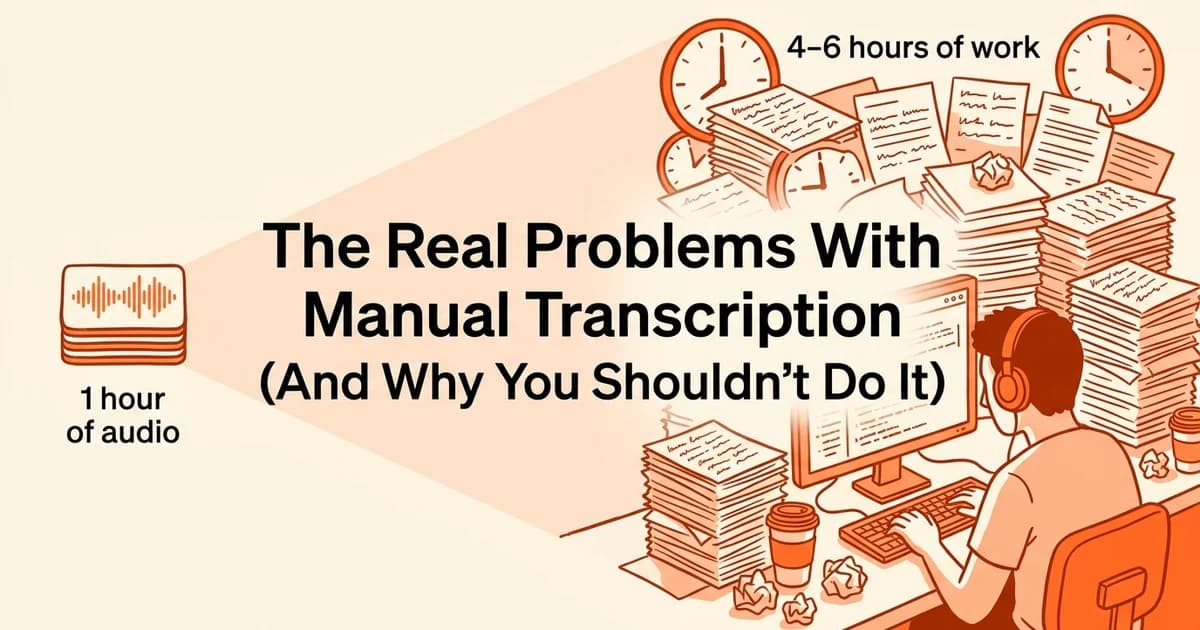
Manual transcription has a stubborn way of eating your day. You hit record, capture something valuable, and then face the real work: playing it back, pausing, typing, rewinding, correcting. For every hour of audio, you can expect to spend four to six hours turning it into text. Multiply that across a week of interviews, lectures, or meetings, and the math gets uncomfortable fast.
The hidden cost nobody talks about
The time burden is obvious. The financial one is less so. Professional manual transcription typically runs between $1.50 and $4.00 per audio minute, which means a single one-hour podcast interview can cost anywhere from $90 to $240. For teams producing content at scale, or students working through hours of recorded lectures, those costs compound quickly.
So why do people still do it?
Accuracy is the honest answer. According to Accuracy Matters: Ditto's Testing, human transcription achieves around 99% accuracy compared to an AI average of 61.92% in testing. For legal records, academic research, or journalism where every word carries weight, that gap matters enormously. Manual transcription also handles heavy accents, crosstalk, and technical vocabulary better than most automated tools.
What this article will help you do
This guide works through the real problems with manual transcription, from accuracy trade-offs to workflow bottlenecks, and gives you practical frameworks for deciding when to go manual, when to use a hybrid approach, and when automation is the smarter call. If you record meetings regularly, Draftery's Voice Transcription feature converts recordings to text across platforms, which can serve as a useful starting point before any manual review pass.
Quick fix: deciding between manual and hybrid transcription
The fastest way to pick the right transcription method is to match your accuracy requirements, budget, and turnaround time against what each approach actually delivers. For most people, a hybrid workflow, where AI handles the first pass and a human reviews the output, hits the best balance of speed and quality.
Assess your accuracy requirements
Determine the stakes of your transcription. Legal, medical, and compliance work demands 99% accuracy. General notes, meeting summaries, and content research can tolerate lower accuracy rates. This decision shapes everything that follows.
Calculate your time and budget constraints
Manual transcription costs $1.50–$4.00 per audio minute and requires 4–6 hours of work per audio hour. Automated transcription costs $0.10–$0.30 per minute. Map these costs against your available resources and deadlines.
Evaluate turnaround time needs
If you need results in hours, automated or hybrid workflows are essential. If you have days or weeks, pure manual transcription becomes more feasible. Hybrid approaches typically deliver in 24–48 hours with minimal manual review.
Match method to use case
High-stakes content (legal, medical, regulatory) → professional human transcription. General business use → hybrid workflow. Internal notes and rough drafts → AI-only transcription. This alignment prevents costly rework.
When to use manual transcription exclusively
Manual-only transcription makes sense in a narrow set of situations:
- Legal or medical records where verbatim accuracy is a compliance requirement
- Heavy accents, overlapping speakers, or technical jargon that consistently trips up AI tools
- Highly sensitive content where routing audio through a third-party server is not acceptable (see our guide to choosing a secure transcription service)
When hybrid works better
For the majority of podcasters, journalists, and business teams, hybrid transcription is the practical default. According to Sonix (2024), professionals who combine AI transcription with human review report significantly faster turnaround without sacrificing accuracy.
A simple cost-benefit snapshot:
| Method | Speed | Cost | Accuracy ceiling |
|---|---|---|---|
| Manual only | Slow | High | Very high |
| AI only | Fast | Low | Variable |
| Hybrid | Fast | Moderate | High |
The hybrid model works especially well when you get started with a free transcription trial today to benchmark AI accuracy on your specific audio before committing to a full workflow.
Why manual transcription takes so long and costs so much
Manual transcription is expensive because it is genuinely hard work. The time, cognitive effort, and quality control involved all add up quickly, and the pricing reflects that reality. Understanding exactly where the hours and dollars go helps explain why so many professionals are rethinking the process entirely.
The 4–6 hour reality of transcribing audio
A common misconception is that transcribing one hour of audio takes roughly one hour. In practice, it takes between four and six hours. Transcriptionists must pause, rewind, and replay constantly to catch every word accurately. Fast speakers, overlapping voices, background noise, and technical jargon all slow the process further. For interview transcription especially, where multiple speakers trade turns rapidly, that upper estimate of six hours per audio hour is not unusual at all.
The cognitive load is heavier than it looks
Transcription is not passive listening. A transcriptionist is simultaneously processing audio, typing at speed, monitoring accuracy, and tracking who said what. These tasks compete for the same mental bandwidth. Fatigue sets in faster than most desk jobs, which means error rates climb as sessions lengthen. Maintaining focus across a two-hour recording is genuinely exhausting work.
Quality control adds even more time
Raw transcripts are rarely finished transcripts. Speaker attribution, industry-specific terminology, proper nouns, and formatting all require a dedicated review pass. In legal, medical, or academic contexts, that review is non-negotiable. According to Accuracy Matters via EIN Presswire, skilled human transcriptionists achieve around 99% accuracy, but reaching that standard consistently demands careful checking, not just fast typing.
What the pricing actually reflects
That labor intensity is baked directly into market rates. Professional manual transcription typically runs between $1.50 and $4.00 per audio minute, meaning a single one-hour podcast episode can cost anywhere from $90 to $240. For teams producing content regularly, those costs compound fast.
Solution 1: hybrid transcription workflow for quality and efficiency
The good news is that you don't have to choose between paying premium rates for full manual transcription and accepting the messy output of pure AI. A hybrid workflow threads the needle by letting automated tools handle the heavy lifting, then bringing in a human to clean up what machines get wrong. The result is accuracy close to fully manual work, at a fraction of the cost.

How the hybrid process works step by step
The workflow follows three clear stages, each with a distinct purpose:
- Automated first draft. An AI transcription tool processes your audio and produces a raw transcript, typically in minutes rather than hours. This is where you capture the bulk of the text without any manual effort.
- Human correction pass. A trained reviewer goes through the AI draft, fixing errors, adding speaker labels, and resolving anything the model misheard. This pass takes significantly less time than transcribing from scratch because the reviewer is editing, not typing.
- Final quality review. A second set of eyes checks for consistency in terminology, proper nouns, and formatting before the transcript is delivered or published.
This structure works because it targets human attention exactly where AI struggles most. Pure AI transcription has well-documented weak spots: research published in the ACH anthology found that tools like Whisper produced missing word rates of 19.2% and added word rates of 28.5%, particularly on accented speech and domain-specific vocabulary. A human reviewer catches those gaps efficiently because they already have a readable draft in front of them.
Quality control checklist for the correction pass
When reviewing an AI-generated draft, focus your attention on these common failure points:
- Speaker labels: Verify that every speaker turn is correctly attributed, especially in multi-person conversations where voices overlap
- Accents and dialects: Flag any passages where the AI clearly substituted a similar-sounding word for the intended one
- Technical terminology: Check industry jargon, product names, and proper nouns against a reference glossary if one exists
- Filler word handling: Decide whether to retain or remove filler words consistently throughout, rather than leaving the AI's inconsistent choices in place
- Timestamps: Confirm that timestamps align with the audio if they're required for captions or compliance purposes
The cost and time case for going hybrid
The numbers behind hybrid transcription are compelling. A 2026 study on hybrid workflows found a character-error rate of just 2.14%, alongside a 66% reduction in cost and 83% higher throughput compared to fully manual transcription. That means you're getting near-human accuracy while cutting your budget by more than half and turning transcripts around dramatically faster.
For content creators producing regular episodes, or business teams working through weekly meeting recordings, those savings add up quickly. If you're already exploring your options, our guide to the best transcription software breaks down which tools perform well as the automated first-draft layer in exactly this kind of workflow.
Solution 2: professional human transcription for high-stakes content
Sometimes good enough simply isn't good enough. For legal depositions, medical records, regulatory filings, and accessibility compliance, a single misheard word can change the meaning of a sentence, expose an organization to liability, or exclude a person with a disability from content they have a legal right to access. In those situations, professional human transcription is the appropriate choice.
When accuracy is non-negotiable
The accuracy gap between human and automated transcription is wider than most people expect. According to Ditto Transcripts, human transcription achieves 99% accuracy compared to an AI average of just 61.92%. That is not a marginal difference. It means that in a 60-minute legal deposition, AI could be misrepresenting dozens of exchanges that a trained human transcriber would capture correctly.
The stakes are especially high in:
- Legal proceedings: Depositions, court hearings, and contracts where word-for-word accuracy is a professional and legal requirement
- Medical documentation: Clinical notes, patient consultations, and diagnostic records where terminology errors can affect care
- Regulatory submissions: Compliance filings where inaccuracies can trigger audits or penalties
- Accessibility content: Closed captions and transcripts required under ADA and WCAG guidelines, where errors undermine the purpose of the accommodation
How professional transcribers handle difficult audio
Professional transcription services earn their rates by handling what automated tools consistently fail at: overlapping speakers, heavy accents, technical jargon, poor recording conditions, and emotional or rapid speech. Trained transcribers use context, domain knowledge, and active listening to resolve ambiguities that an algorithm simply skips or guesses at.
Most reputable services also build quality assurance into their process. A typical workflow includes a primary transcriber, a secondary reviewer, and a final proofreading pass against the original audio. This multi-stage approach is what produces the 99% accuracy figure rather than the industry average.
Turnaround times and what to expect
Professional human transcription is slower than automated alternatives, typically ranging from a few hours to a few business days depending on audio length, complexity, and the service tier you choose. Most providers offer service-level agreements with guaranteed turnaround windows, which matters when you are working to a legal deadline or a broadcast schedule.
For teams managing a high volume of sensitive recordings, pairing a professional transcription service with a centralized tool to store and organize the resulting transcripts keeps everything searchable and accessible. A dedicated team transcription tool can bridge that gap between the transcription itself and the workflow that follows.
Solution 3: optimizing your own manual transcription process
Sometimes outsourcing isn't an option. Budget constraints, confidentiality concerns, or sheer preference mean you're sitting down to transcribe the audio yourself. If that's the case, the goal is to work as efficiently as possible and protect the quality of the output.
Discover how Email Reply Drafting approaches manual transcription Email Reply Drafting.
Prepare your audio before you start
Reduce background noise, normalize volume levels, and break long recordings into 15–30 minute segments. Clean audio cuts transcription time by 20–30% and reduces errors from mishearing.
Use playback tools strategically
Employ transcription software with variable playback speed (0.75x–1.0x), keyboard shortcuts for pause/rewind, and foot pedal support. These tools reduce physical strain and keep your hands on the keyboard.
Transcribe in focused sessions
Work in 45–60 minute blocks with 10–15 minute breaks. Cognitive fatigue increases errors exponentially after 90 minutes. Multiple shorter sessions produce better accuracy than one marathon session.
Build in review and correction time
Reserve 20–30% of your total time for a second pass. Listen while reading your draft to catch mishearings, typos, and formatting issues. This step is non-negotiable for accuracy above 90%.
Set yourself up with the right tools
The single biggest time-saver for manual transcription is a foot pedal. This small device lets you pause, rewind, and play audio without touching your keyboard, keeping your hands free to type continuously. Paired with playback speed controls (most transcription software lets you slow audio to 50-75% of normal speed), you can dramatically cut the number of times you need to stop and restart.
Keyboard shortcuts matter too. Learning the hotkeys in whichever audio player or transcription app you use means fewer interruptions and a steadier typing rhythm.
Break the audio into manageable segments
Trying to transcribe a 60-minute recording in one sitting is a reliable way to introduce errors. Research suggests the average person takes four to six hours to transcribe a single hour of audio, and fatigue compounds mistakes as that time stretches on. Working in 10 to 15 minute chunks with short breaks between them keeps your focus sharper and your accuracy higher.
Build a glossary before you start
If your recording includes technical terminology, names, or industry jargon, write them down before you begin. A quick reference list means you're not stopping mid-sentence to look up a spelling or second-guess a term. This is especially useful for interviews, medical content, or legal recordings where precision is non-negotiable.
Proofread with fresh ears
Never proofread immediately after finishing. Step away, then read the transcript while playing back the audio at a slightly faster speed. Catching errors in context is far more effective than reading the text alone. According to Sonix, transcription accuracy directly affects downstream decisions, which makes this final quality-control pass worth the extra time.
For teams who record meetings regularly, Draftery's Voice Transcription feature converts recordings to text across multiple platforms, giving you a cleaner starting point if you need to review or lightly edit rather than transcribe from scratch. You can also check transcription service pricing to weigh whether your time investment in manual work is actually the most cost-effective route.
Prevention: choosing the right transcription method upfront
The smartest way to avoid transcription headaches is to make the right method choice before you ever hit record. Matching your workflow to the correct approach from the start saves time, money, and frustration, and it begins with an honest assessment of three things: your content type, your accuracy requirements, and your budget.

Matching method to use case
Not every recording needs the same level of care. A simple decision framework helps here:
- Legal, medical, or compliance content: Human transcription is non-negotiable. According to Accuracy Matters: Ditto's Testing, human transcription achieves roughly 99% accuracy compared to AI's average of 61.92%, a gap that matters enormously when a misheard word could have real consequences.
- Routine meetings and team calls: A hybrid approach works well. AI handles the first pass, and a human reviewer catches errors in context-sensitive language, names, or technical terms.
- Personal notes and dictation: AI-only transcription is usually sufficient. Speed and convenience outweigh the need for perfection.
Capturing clean audio from the start
No transcription method, human or automated, can fully compensate for poor source audio. A few habits make a significant difference:
- Use a dedicated microphone rather than a built-in laptop mic
- Record in a quiet space and minimize background noise
- Keep speakers close to the microphone and avoid talking over each other
For teams recording calls regularly, tools like Draftery's Meeting Capture app record both sides of calls across Zoom, Meet, and Teams without requiring a bot to join, giving you cleaner, more usable audio from the outset.
Documenting context before you transcribe
Before transcription begins, write down speaker names, relevant acronyms, and any technical vocabulary specific to the conversation. This small upfront step dramatically reduces errors, whether you are transcribing manually, using a podcast transcription service, or reviewing an AI-generated draft.
Building these preparation habits into your content creation process means transcription becomes a predictable, manageable step rather than a last-minute scramble.
When to seek professional help: escalation guide
Sometimes preparation is not enough. Certain transcription scenarios are genuinely beyond what any individual, or even a standard AI tool, should attempt alone. Knowing when to escalate is as important as knowing how to prepare.
Red flags in your audio
If your recording involves any of the following, professional human transcription is worth the investment:
- Multiple overlapping speakers who frequently interrupt or talk simultaneously
- Heavy regional accents or non-native speech patterns that trip up automated tools
- Significant background noise, such as crowd ambience, music, or poor microphone quality
- Dense technical, legal, or medical terminology where a single misheard word changes meaning entirely
According to Accuracy Matters: Ditto's Testing, human transcription achieves around 99% accuracy compared to an AI average of just 61.92%, a gap that becomes critical when the content is specialized or complex.
Time pressure and volume
When a deadline is tight and the audio is long, manual transcription simply does not scale. A professional service or a structured AI-assisted workflow, like using a lecture transcription service for academic content, can compress turnaround from days to hours.
Compliance and legal requirements
Regulated industries, including healthcare, legal, and finance, often require documented accuracy standards. In these contexts, a professional transcriber with relevant domain knowledge is not optional. It is a risk management decision.
Vetting a professional service
When evaluating providers, look for:
- Domain specialization relevant to your content type
- Transparent accuracy guarantees with revision policies
- Clear data privacy and confidentiality agreements
- Verifiable turnaround times and sample work on request
Conclusion: manual transcription in a hybrid world
Manual transcription is slow, expensive, and for most everyday use cases, no longer necessary. The data backs this up: according to Sonix, professionals are rapidly shifting toward automated tools, and the productivity gains are hard to ignore.
That does not mean you should abandon human judgment entirely. The hybrid approach, using AI to handle the heavy lifting and reserving human review for high-stakes or complex content, is the practical middle ground most people land on once they have experimented with both.
The right method depends on your situation. A student capturing lecture notes has very different needs from a journalist transcribing a source interview or a compliance team documenting a regulated meeting. Knowing where your content falls on that spectrum is the first step to choosing wisely.
If voice capture and organization are part of your workflow, tools like Draftery are worth exploring. Its voice transcription and Draftery Library features let you convert recordings to text and search across them later, keeping your captured audio from becoming a pile of forgotten files.
Start simple, test what works, and scale your process from there. The goal is accuracy and efficiency, not perfection on the first attempt.
Frequently asked questions
How long does it take to manually transcribe one hour of audio?
According to Sonix (2026), manual transcription commonly requires four to six hours of work for every hour of audio. The exact time depends on audio quality, speaker accents, and the transcriptionist's experience level.
How accurate is manual transcription?
Manual transcription accuracy typically reaches around 99% when performed by a skilled professional. By comparison, Ditto Transcripts, as reported by EIN Presswire (2025), found that eight tested AI platforms averaged just 61.92% accuracy across legal, medical, and business recordings.
Is manual transcription better than AI transcription?
It depends on your priorities. Manual transcription wins on accuracy, especially for complex audio. AI transcription wins on speed and cost, making it the better fit for most everyday workflows.
How much does manual transcription cost?
Professional human transcription typically runs $1.50 to $4.00 per audio minute, compared with $0.10 to $0.30 for automated alternatives.
What is the difference between manual and automated transcription?
Manual transcription involves a human listener typing out speech word by word. Automated transcription uses AI speech recognition to generate text almost instantly, trading some accuracy for significant gains in speed and affordability.
Why is manual transcription so time-consuming?
Humans can only type so fast, and audio often needs to be paused, rewound, and replayed repeatedly. Background noise, overlapping speakers, and unclear pronunciation all add extra review time.
Can I manually transcribe an audio recording for free?
Yes. Any recording can be transcribed manually at no financial cost using just your ears and a word processor. The real cost is your time, typically several hours per recorded hour.
When should I use a human transcriptionist instead of AI?
Choose a human transcriptionist for high-stakes content where accuracy is non-negotiable, such as legal depositions, medical records, or formal interviews. For everyday voice notes and meeting capture, tools like Draftery offer voice transcription across multiple platforms without the time or expense of manual work.