The Guide to AI for Email Management
Feel like you're constantly digging out from under a mountain of emails? You're definitely not alone. When we talk about AI for email management, we're not picturing a futuristic robot taking over your inbox. Think of it more like a smart, personal assistant—one that handles the grunt work of sorting, drafting, and summarizing so you can get back to focusing on what matters. It's the beginning of the end for inbox overload.
How AI for Email Management Reclaims Your Day

If your inbox feels like a to-do list that never ends, you’re dealing with a problem that almost every professional faces. That constant stream of messages, follow-ups, and notifications isn't just an annoyance; it’s a massive drag on productivity, eating away at your most valuable asset: time.
Think of AI for email management as a highly advanced filter and co-pilot for your communications. Instead of you having to manually sift through every single message, figure out what's important, and then block out hours to write replies, the AI does the heavy lifting for you. It learns what you prioritize, understands the context of a conversation, and can even adapt to your unique writing style.
The Real Cost of Email Overload
The consequences of drowning in email are surprisingly high. The average professional spends over 250 hours per year just on email. For a founder getting 50+ emails a day, that can easily add up to 12.5 hours per week spent just on writing responses. This isn’t just lost time; it’s a massive loss of opportunity. Every minute you spend crafting a routine reply is a minute you aren't spending on strategy, building client relationships, or doing the deep work that grows your business.
The shift to AI is already paying off for many. Companies using specialized AI agents for email are often seeing a positive return on their investment within the first year. You can dive deeper into the data with these insights from Gmelius on AI's impact.
The goal of AI isn't to replace your voice but to amplify it. It handles the repetitive tasks, allowing you to focus on the high-value communication that drives your business forward.
From Inbox Chaos to Calm Control
So, how does this technology actually translate into a calmer, more productive day? The real value is in how it solves some of the most frustrating and persistent email problems. Instead of offering a one-size-fits-all fix, AI delivers specific, automated help that fits right into your workflow.
The table below breaks down the common email headaches we all face and how AI for email management directly solves them, turning daily pain points into genuine efficiencies.
How AI Transforms Your Email Workflow
| Common Email Challenge | How AI for Email Management Solves It |
|---|---|
| Endless Drafting | The AI generates ready-to-send draft replies based on the email's context and your personal writing style, cutting composition time dramatically. |
| Inbox Triage Anxiety | It automatically identifies and prioritizes important emails, separating urgent messages from newsletters and low-priority updates. |
| Information Overload | AI summarizes long email threads into concise bullet points, so you can grasp the key takeaways in seconds without reading every reply. |
| Inconsistent Tone | Advanced tools like Draftery learn how you communicate with different people, ensuring your tone is always appropriate for the recipient. |
By automating these core tasks, you can finally move from being reactive to proactive. You’ll spend less time managing your inbox and more time acting on the opportunities hiding within it. You can finally achieve that elusive state of "inbox zero"—not by working harder, but by working smarter.
How AI Learns to Write Like You
The biggest question I hear about using AI for email management is a simple one: "Will it actually sound like me?" It’s a great question. Nobody wants an AI assistant cranking out generic, robotic text that screams, "I didn't write this."
But modern AI tools have come a long way from basic templates. The real magic happens when an AI learns your personal communication style, creating drafts that aren't just grammatically correct, but genuinely sound like you. This process combines powerful technology with your own email history to build a digital fingerprint of your writing voice.
The AI as an Apprentice
Think of your AI email assistant as a new apprentice. On day one, this apprentice knows nothing about how you talk to people. To learn the ropes, they need to study your past work. In this case, that "past work" is your sent email folder.
By analyzing the emails you've already written, the AI starts to pick up on your patterns. This is all driven by a technology called Natural Language Processing (NLP), which is just a fancy term for teaching computers to understand human language. Instead of just seeing a jumble of words, the AI starts to see context, relationships, and what you’re trying to say.
It learns things like:
- Your Go-To Greetings: Do you start emails with "Hi [Name]," "Hey," or a more formal "Dear [Name]"?
- Your Signature Sign-Offs: Are you a "Best," "Thanks," or "Cheers" person?
- Common Vocabulary: What industry jargon, acronyms, or favorite phrases do you use all the time?
- Sentence Structure and Length: Do you prefer short, punchy sentences or more detailed, longer thoughts?
Through this analysis, the AI builds a foundational model of your unique voice. Every email it looks at adds another layer of detail, sharpening its understanding of your style.
From General Style to Specific Tone
Getting your general voice down is just the first step. Truly smart AI, like the technology we've built into Draftery, takes this a step further by learning how your style changes depending on who you're talking to. Let's be honest, you don't write to your CEO the same way you write to a close colleague.
The AI creates distinct "relationship profiles" for your contacts. It notices that with your investors, you're more formal and stick to the data. With your marketing team, you might use a few emojis and a more casual tone.
This per-recipient analysis is the key to authenticity. The AI doesn’t just learn one version of your voice; it learns all the subtle variations you use every day, ensuring that every draft is appropriate for the situation.
This means the draft reply for an urgent client complaint will feel completely different from a quick follow-up with a friendly vendor. By recognizing these nuances, the AI can produce drafts that not only save you time but also protect the important relationships you’ve worked so hard to build. If you're curious about how this works, you can learn more about our free email tone analyzer tool.
The Feedback Loop That Makes AI Smarter
The learning never really stops. An AI email assistant isn't a "set it and forget it" tool; it's a dynamic system that gets better with every single interaction. This is where machine learning kicks in.
Think about what these simple actions teach the AI:
- You send a draft as-is: This is a huge thumbs-up. The AI learns, "Okay, this was a perfect match for this person and this situation."
- You edit a draft slightly: The AI compares your changes to its original text and learns to adjust its approach for similar emails in the future.
- You delete a draft and write your own: This is a clear signal that the AI missed the mark, which tells it to rethink its strategy for that type of conversation.
Each of these actions creates a continuous feedback loop. Over time, the AI's suggestions become more and more accurate, needing fewer and fewer tweaks. The goal isn't to replace your judgment; it's to give you a better starting point that gets closer to your final message with every email you send, making it a powerful partner in your day-to-day communication.
Putting AI Email Tools to Work
It’s one thing to understand the theory behind how AI learns your writing style, but it’s another thing entirely to see it in action. This is where the real "aha!" moment happens. So, let's shift from concepts to concrete examples and explore the core functions that make these tools so incredibly useful.
We'll focus on four key capabilities that can genuinely change your daily routine: automated triage, intelligent drafting, email summarization, and smart automation. For each, I’ll share a real-world scenario to show you exactly how they solve problems for busy people.
Automated Triage and Prioritization
Think of your inbox as a chaotic mailroom. Without someone sorting the mail, urgent invoices get mixed in with junk mail, and everything ends up in one giant, stressful pile. An AI triage system is that expert sorter. It automatically identifies, categorizes, and prioritizes your incoming messages so you can focus on what actually needs your attention right now.
This is much more sophisticated than the simple filters you might be used to. The AI looks at who the sender is, keywords, and the conversational context to tell the difference between a high-stakes client request and a routine newsletter. Over time, it learns that emails from your top investors are always high-priority, while promotional messages can wait.
Real-World Example: A project manager starts her day with 40 new emails. Instead of manually scanning every single one, her AI assistant has already flagged the three most critical messages: a bug report from a key client, a meeting request from her director, and a question from a teammate who is blocked. The rest are neatly sorted away, letting her tackle the big stuff first and start her day with a clear head.
Intelligent and Context-Aware Drafting
This is where modern AI for email management truly shines. Instead of just giving you generic, one-line "smart replies," today's tools can generate complete, thoughtful drafts that sound just like you wrote them. The AI reads the email you received, understands the sender's intent, and even references your past conversations to create a response that is both relevant and personal.
This is how an AI learns to capture your unique voice and style.

As you can see, it’s all about analyzing your email history and building a model of how you communicate. This is exactly how a tool like our AI email writer can produce drafts that feel so authentic you’ll forget you didn't write them yourself.
Real-World Example: A freelance consultant gets an inquiry about her services. The AI drafts a reply that not only answers the prospect's questions but also includes a link to her portfolio and suggests booking a call—all phrased in her typically friendly yet professional tone. All she has to do is give it a quick review and hit send, saving herself a good 15 minutes.
Quick Email Summarization
We’ve all been there—staring at a massive email thread with dozens of replies, trying to figure out what’s going on. It’s a huge productivity killer. AI summarization solves this by condensing entire conversations into a few clear, digestible bullet points.
The AI is smart enough to pull out the key decisions, action items, and outstanding questions buried in all that back-and-forth. This lets you get the gist of a long discussion in seconds, not minutes.
Real-World Example: A sales executive returns from vacation to a major client deal in progress. Instead of wading through 50+ emails, she uses an AI summarizer to get a quick overview. In under a minute, she knows the client raised a budget concern, the tech team confirmed a new feature, and a final decision is due by Friday. She's fully up to speed and ready to jump back in.
Smart Automation for Follow-Ups
Beyond just drafting a single reply, AI can automate entire sequences of communication. This is incredibly powerful for tasks like following up on proposals, sending reminders for unpaid invoices, or nudging contacts who have gone quiet.
The impact here is massive. For instance, automated email flows now drive an astonishing 37% of all email-generated revenue while making up only 2% of total sends. They also see a 332% higher click rate than standard campaigns, proving just how effective smart automation can be.
Real-World Example: A startup founder sends an update to a list of potential investors. She sets up her AI to automatically send a personalized follow-up one week later to anyone who hasn't replied. This simple automation ensures no promising lead falls through the cracks and frees her from the tedious task of manually tracking every single person.
Choosing the Right AI Email Assistant
The market for AI for email management is getting crowded. With so many tools popping up, it’s tough to know which ones are genuinely helpful and which are just buzz. Picking the wrong assistant can backfire, leaving you with robotic replies that damage relationships instead of building them.
So, how do you find the right fit? It really comes down to your specific needs, your daily workflow, and how much you value privacy. To make a smart choice, you need to look at three things: how well it captures your voice, how smoothly it fits into your day, and how seriously it takes your data.
Evaluating Personalization and Authenticity
The most critical test for any AI email tool is simple: does it sound like you? If it spits out generic, stilted drafts, you’ll spend more time fixing them than you would have spent writing the email from scratch. This is where most tools fall flat.
A truly helpful AI understands nuance. It doesn’t just mimic a single writing style; it learns how your tone changes depending on who you’re talking to. The way you email your CEO is probably different from how you email a close colleague, and a good tool gets that. This is what separates the basic assistants from the truly advanced ones.
Here’s what to look for:
- Voice Matching: Does it analyze your past emails to learn your go-to phrases, greetings, and sign-offs?
- Per-Recipient Tone: Can it adjust its style for different people, so every draft feels appropriate for that specific relationship?
- Feedback Loop: Does the AI learn from the changes you make, getting smarter and more accurate over time?
If an AI can’t get your voice right, its time-saving promises are empty. You'll just be trading one task for another.
Assessing Integration and Workflow Fit
The best AI for email management tools are the ones you forget are even running. They should feel like a natural part of your inbox, not another app you have to juggle. If you have to constantly switch windows or copy-paste text, the "assistance" just becomes more busywork.
A clunky tool adds friction to your day, creating more clicks instead of reducing them. You want something that works with you, not against you.
The gold standard is a tool that works silently in the background. It should deliver its value—like a ready-to-go draft—right inside your email client, without forcing you to change your habits.
When checking out a tool, ask yourself:
- Native Experience: Does it work directly inside Gmail or Outlook?
- Level of Automation: How much manual effort is required? Does it draft replies automatically, or do you have to prompt it every single time?
- User Control: Can you easily edit or ignore suggestions without a hassle?
The table below gives you a quick look at how different types of AI email tools stack up.
Feature Comparison: Key AI Email Management Tools
| Feature | Generic AI Writers | Basic Email Assistants | Advanced Personalization Tools |
|---|---|---|---|
| Personalization | Low (Generic, one-size-fits-all) | Medium (Learns basic style) | High (Learns your voice and per-recipient tone) |
| Workflow | Poor (Requires copy-pasting) | Fair (Browser extension, manual triggers) | Excellent (Native to inbox, automated) |
| Learning | None (Stateless) | Minimal (Some learning from edits) | Continuous (Adapts from every edit) |
| Privacy | Often poor (Data used for training) | Mixed (Varies by provider) | Strong (Privacy-first by design) |
This comparison helps clarify where different solutions fit in. Advanced tools like Draftery are built from the ground up to provide deep personalization and a seamless workflow, setting them apart from more generic options.
This shows how tools designed for personalization really focus on working within your existing flow while delivering a much higher degree of authenticity. If you're interested in going deeper, you can learn more about how to choose the right AI email assistant for your specific needs.
Verifying Security and Data Privacy
This might be the most important point of all. When you use an AI email tool, you’re granting it access to some of your most sensitive professional conversations. You absolutely have to be sure your data is being handled responsibly.
Many people are rightly concerned about how AI companies use their data, and a vague privacy policy is a huge red flag. Look for companies that are crystal clear about what they do—and, just as importantly, what they don't do—with your information.
A privacy-first AI assistant will make these commitments:
- No Model Training: Your emails should never be used to train their global AI models. Period.
- Data Encryption: All of your data must be encrypted, both when it's being sent and when it's stored.
- User Control: You should be able to disconnect your account and permanently delete all of your data at any time.
- Read-Only Access: The tool should only need permission to read emails to generate drafts—not to send, delete, or change anything in your account.
Ultimately, choosing the right tool is a balancing act between these three pillars: authentic personalization, a smooth workflow, and rock-solid privacy. By focusing on these areas, you can find a true partner for your inbox, not just another piece of software.
Implementing AI in Your Email Workflow
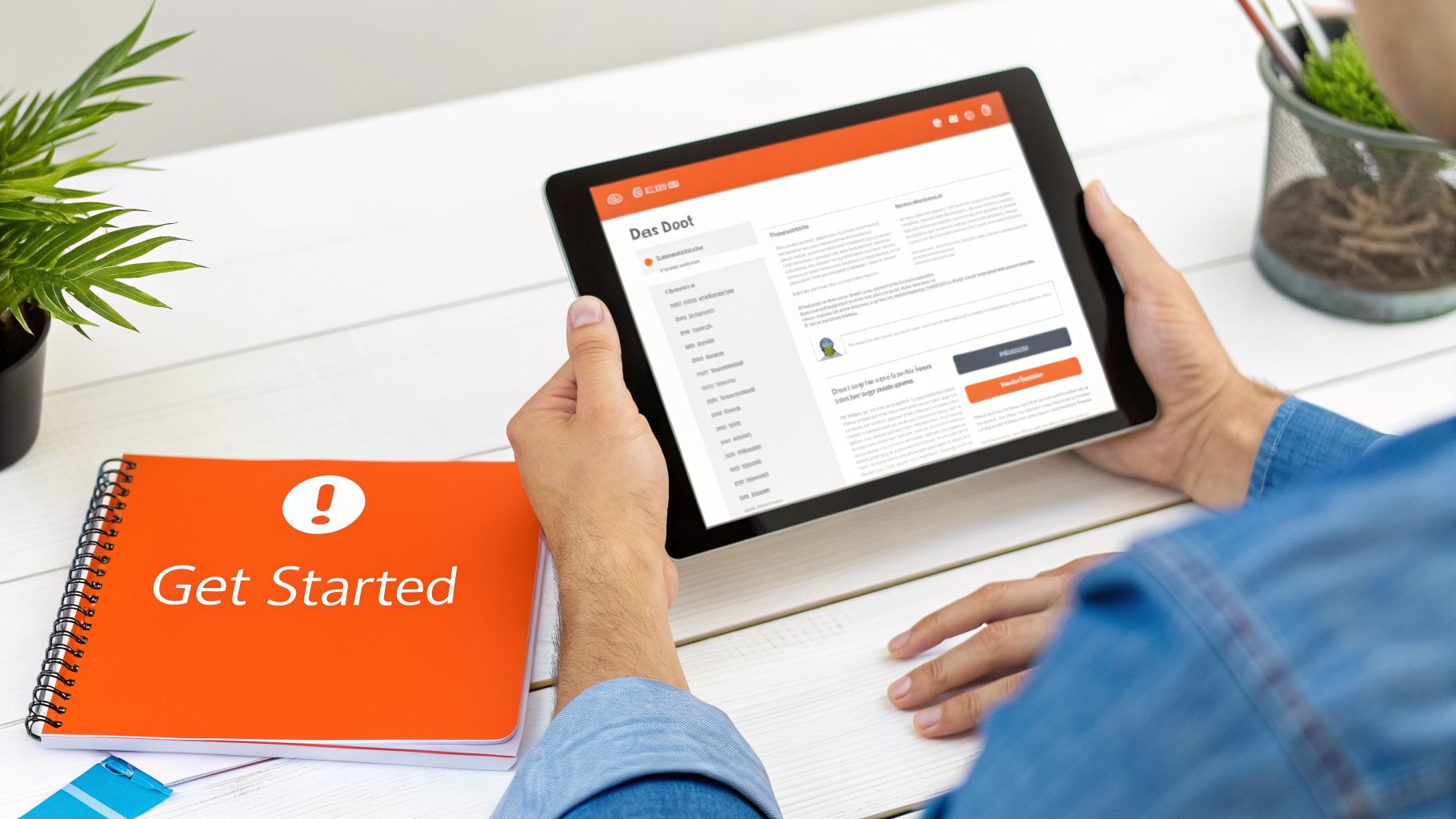
Bringing a new tool into your daily routine can feel like a huge commitment, but getting started with AI for email management is much easier than you might think. The best tools are designed to fit right into your day without causing any disruption. Forget about complicated installations or needing to know how to code—modern AI assistants connect in just a few clicks.
This section will walk you through, step by step, how to bring AI into your everyday work. We'll cover everything from connecting your account to letting the AI learn your style and reviewing your first drafts. By the end, you'll see just how simple it is to start saving time right away.
Your First Steps with an AI Assistant
Getting set up is designed to be quick and, most importantly, secure. With a privacy-focused tool like Draftery, the whole process takes about a minute and only requires read-only access to your Gmail account. This is a critical security detail: the AI needs to read emails to figure out how to reply, but it has no power to send, delete, or change anything on your behalf.
Here’s what that initial onboarding looks like:
- Connect Your Account: You’ll link your email account (like Gmail) through an official, secure authorization pop-up. It's a single click, and your password is never shared.
- Let the AI Analyze: The system then starts looking through your sent mail to understand your personal writing style. This all happens quietly in the background and is the secret to getting drafts that actually sound like you.
- Receive Your First Draft: The next time an email lands in your inbox that needs a response, the AI will automatically create a draft and pop it into your Drafts folder, ready for you to look over.
This initial analysis is what separates a generic gadget from a true personal assistant. The AI isn’t just scanning for keywords; it’s learning your specific vocabulary, how you structure your sentences, and even your go-to greetings and sign-offs for different people.
The Feedback Loop That Makes AI Smarter
An AI email assistant isn't a "set it and forget it" tool—it's a learning system that improves with every single email you handle. This happens through a constant feedback loop that you drive. You are always in the driver's seat, and every decision you make helps the AI get better at sounding like you.
Think of it this way:
- You send a draft as-is: This tells the AI, "Perfect. Do more of this." It confirms the draft was a great fit for the situation.
- You edit a draft: The AI takes note of your changes and compares them to what it first suggested. This is how it learns the specific nuances it missed, helping it get closer next time.
- You delete a draft and write your own: This sends a strong signal that the AI's idea was off-track, pushing it to rethink its approach for similar conversations in the future.
This feedback cycle is what creates genuine authenticity over time. You’re not just a user; you’re actively teaching the AI to be a better assistant, making sure it adapts to your style as it evolves.
This learning process is fundamental to making AI for email management work for you long-term. One of the biggest initial complaints about AI-generated text is that it can sound robotic. By constantly guiding it with your edits, you train the AI to move past generic phrases and adopt your real voice.
How to Measure Your Success
So, how do you know if your new AI assistant is actually helping? The best way is to look for real, measurable improvements in your daily work. Instead of just "feeling" more productive, you can track specific metrics.
Start by keeping an eye on these key performance indicators (KPIs):
- Time Saved Per Day: A recent experiment found that AI can cut down the time spent on writing tasks by up to 40%. Try timing how long you spend on email for one day without AI, and then one day with it. Even saving just 10–15 minutes a day adds up to hours every month.
- Response Time: Are you able to get back to important clients and colleagues faster? A quicker response can directly improve relationships and open up new opportunities.
- Drafts Sent vs. Edited: Pay attention to how many AI-generated drafts you can send with few or no edits. As this number goes up, it’s a clear sign the AI is getting your voice right.
By focusing on these numbers, you can see the real value your AI assistant is providing. You'll go from drowning in an overwhelming inbox to effortlessly directing your communication—all while winning back valuable hours for the work that truly matters.
The Future of Professional Communication
So, where does this leave us? We've walked through how AI for email management works, but the real takeaway isn't about the technology itself. It’s about getting back the time and mental energy that the daily grind of inbox management steals from us. Think of it as a tool that helps you communicate better, not less.
As we wrap up, the most important thing to remember is the need for tools that put you in control and fiercely protect your privacy. The future isn't a sci-fi world where our algorithms chat with each other. It’s a future where AI filters out the noise, letting you focus on what really matters: strategic thinking, creative problem-solving, and building the genuine relationships that actually move the needle.
From Just Efficiency to True Empowerment
The real magic of adding AI to your workflow isn’t just about getting things done faster. Sure, studies show it can slash the time spent on writing tasks by up to 40%, but the true value is in what that extra time gives you: empowerment. When you're not drowning in a sea of messages, you finally have the headspace to be more thoughtful and intentional.
This kind of technology really becomes a partner, helping you:
- Think Strategically: You can finally stop just reacting to what comes in and start thinking about the bigger picture.
- Build Stronger Relationships: With the grunt work out of the way, you can pour your energy into the human side of your work.
- Do Your Best Work: AI clears the clutter, getting the repetitive tasks out of the way so you can focus on what you were actually hired to do.
The goal is to shift from being an email processor to a strategic communicator. The technology is just the vehicle to get you there.
An AI assistant should amplify your skills, not replace them. It handles the tedious work so your unique voice and strategic insights can shine through in the emails that count.
A New Standard for Our Tools
Looking forward, the tools that win will be the ones that blend into our workflows while respecting our personal style and privacy. The next wave of AI for email management will be all about personalization and trust. We’ll expect solutions that can learn our voice without ever selling out our data.
This shift lets you hand off the task of drafting without handing over your judgment. Every draft is just a suggestion, a starting point that you have the final say on. When you choose tools like Draftery that are built on a privacy-first, user-focused foundation, you’re not just getting new software. You’re investing in a smarter, less stressful, and ultimately more human way to work.
The future isn't about outsourcing your brain; it’s about freeing it up.
Frequently Asked Questions About AI Email Management
It’s completely normal to have a few questions before you hand over any part of your inbox to a new tool. When it comes to AI for email, most people wonder about the same three things: privacy, setup, and cost. Let's dig into those.
Will My Emails Be Kept Private?
This is usually the first and most important question—and the answer should always be a firm "yes." Any AI email assistant worth its salt puts your privacy first, and they do it with specific technical safeguards and clear policies.
Here’s what a truly privacy-focused tool should guarantee:
- Read-only access: The AI can see your emails to learn your style and draft replies, but it should have absolutely no permission to send, delete, or change anything in your inbox.
- No training on your data: Your email content should never be used to train the company's main AI models. Your data is for your benefit only, helping the AI learn your unique voice.
- End-to-end encryption: All your data must be encrypted, both when it's moving between your computer and the server and when it’s stored.
If a company’s privacy policy is vague or hard to understand, consider that a major red flag. Always opt for a provider who is crystal clear about how they handle your information.
Is It Difficult to Set Up?
Thankfully, no. Modern AI email tools are designed to be incredibly simple to get started with. The whole process usually just involves a one-click connection to your email account, whether it's Gmail or another provider, using their official, secure authorization method.
You don't need to be a tech expert or mess with complicated settings. Once connected, the AI quietly gets to work analyzing your past sent emails to learn how you write. You can often start seeing your first AI-generated drafts in just a few hours.
The best tools fit right into how you already work. The point is to take work off your plate, not to give you another complicated piece of software to manage.
How Much Does AI for Email Management Cost?
Pricing can vary, but most of the top tools use a simple subscription model. You can typically expect a standard plan to cost somewhere between $19 to $39 per month.
It's helpful to think about that cost in terms of time saved, not just another monthly bill. If an AI saves you just 30 minutes a day, that’s over 10 hours back in your pocket every month. For a consultant who bills at $150 an hour, the tool pays for itself after drafting just a couple of emails.
Ready to stop drowning in your inbox and start communicating more effectively? Try Draftery and get your first AI-generated drafts—in your unique voice—in minutes. Start your free 7-day trial.